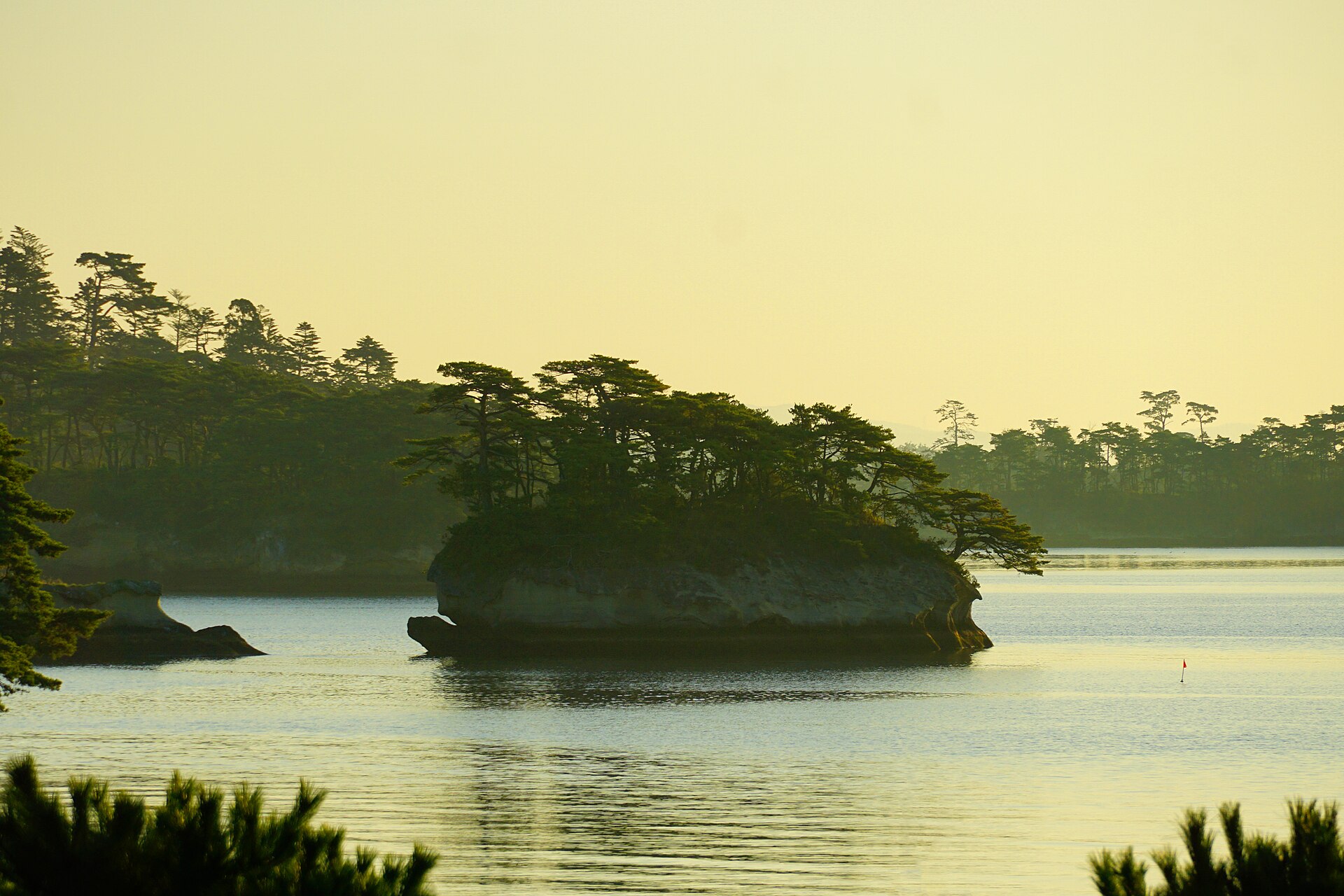

Matsushima means "pine islands", and the name is as plain and exact as the place. Across a shallow bay north-east of Sendai, more than two hundred small islands rise from water the colour of pewter. Each is a lump of pale, soft tuff, undercut by the tide into mushrooms, arches and overhangs, and each wears a crown of black pine, branches bent sideways by centuries of sea wind. Nothing here is large. Everything is composed.
That sense of composition is the point. Matsushima is not a landscape to conquer; it is one you look at, the way you might look at a tray garden or a scroll painting. The islands arrange themselves differently from every shore, every boat deck and every hilltop, and the pleasure lies in moving slowly between those views, letting the scene reassemble itself around you.
The storyOne of the Three Views
In the seventeenth century the Confucian scholar Hayashi Gahō named Matsushima, along with the sandbar of Amanohashidate and the island shrine of Miyajima, as one of the Nihon Sankei, the Three Views of Japan. The list stuck. For nearly four hundred years Matsushima has been shorthand for scenic perfection, and it carries the title lightly, a working fishing town as much as a postcard.
The poet Matsuo Bashō came here in 1689 on the long northern walk that became Oku no Hosomichi, and he had been dreaming of the bay before he set out. Once he arrived, the story goes, he found it so beautiful that he could not settle on a poem of his own. Whether that silence was awe or tact, it has become part of the place: a reminder that some views are better looked at than described.
The bay also bears the stamp of the Date clan, the lords of Sendai. Date Masamune, the one-eyed warlord who founded the castle town of Sendai, rebuilt the Zen temple of Zuigan-ji on the shore in the early 1600s, with timber shipped north from the forests of Kii. Its main hall, with gilded sliding doors and carved transoms, is a National Treasure, and the approach runs through tall cedars past caves cut into the cliff, where monks once meditated and memorial tablets still rest in the rock.
Nothing here is large. Everything is composed.— On the bay at Matsushima
The walkBridges, halls and the water between
Begin at the waterfront with Godaidō, a small hall on a rocky islet reached by a pair of short vermilion bridges. Their decks are built with gaps between the planks, so you see the sea moving beneath your feet as you cross; the tradition is that the gaps are meant to make you mind your step and your thoughts. The hall itself, rebuilt by Masamune, is modest and weathered, its eaves carved with the animals of the zodiac.
From there, follow the shore to Fukuurajima, an island connected to the mainland by a long red footbridge. It is planted as a natural garden, with a looping path through pine and maple, and it is the easiest way to stand in the middle of the bay without a boat. Return by Kanrantei, a teahouse on the shore traditionally said to have come from Fushimi Castle in Kyoto, where you can sit on the tatami with a bowl of matcha and watch the islands through an open frame.
Then take to the water. Cruise boats leave from the central pier and thread between the islands, close enough to see the striped layers of rock, the caves gnawed into their bases and the single pines that cling to ledges where no soil seems possible. On the way you will notice oyster rafts lined up in the shallows; the bay has been farming them for generations. Finally, for the long view, climb one of the hilltop lookouts above the town. The traditional four, known together as the Shidaikan, each frame the bay differently. Ōtakamori, on the island of Miyato, gives the widest panorama of all.
The islands have also proved protective. When the tsunami of 2011 struck this coast, Matsushima was spared the worst of it; the scattered islets are widely credited with breaking the force of the waves before they reached the town. Walking the shore now, the calm feels hard won.
Through the yearWhen to go
Spring
Cherry trees flower around the temples and on the hills above the bay, and the light softens into a pale, milky blue.
Summer
Long, humid days and a summer lantern festival on the water. Mornings are best, before the haze thickens over the islands.
Autumn
Maples burn red around Entsū-in and on Fukuurajima, and clear air sharpens the far islands into silhouettes.
Winter
Oyster season. The bay turns silver and still, and grilled oysters on the waterfront are reason enough to come north.
Know before you goPractical notes
- Day trip from Sendai. The JR Senseki Line runs from Sendai to Matsushima-Kaigan station, a short walk from the pier and the temples.
- See it from three heights. Shore, deck and hilltop each show a different bay. Leave time for at least one lookout, not just the cruise.
- Cross Fukuurajima on foot. It is the quietest way to stand among the islands, and its path is easy and shaded.
- Eat oysters in season. From late autumn through winter the waterfront grills them in the shell; in warmer months look for conger eel and local seafood bowls.
- Mind the gaps. The see-through bridges to Godaidō are uneven by design. Wear sensible shoes and keep a hand on the rail.
- Stay the night. Inns along the bay are at their best after the day visitors leave, when the islands darken and the water goes quiet.