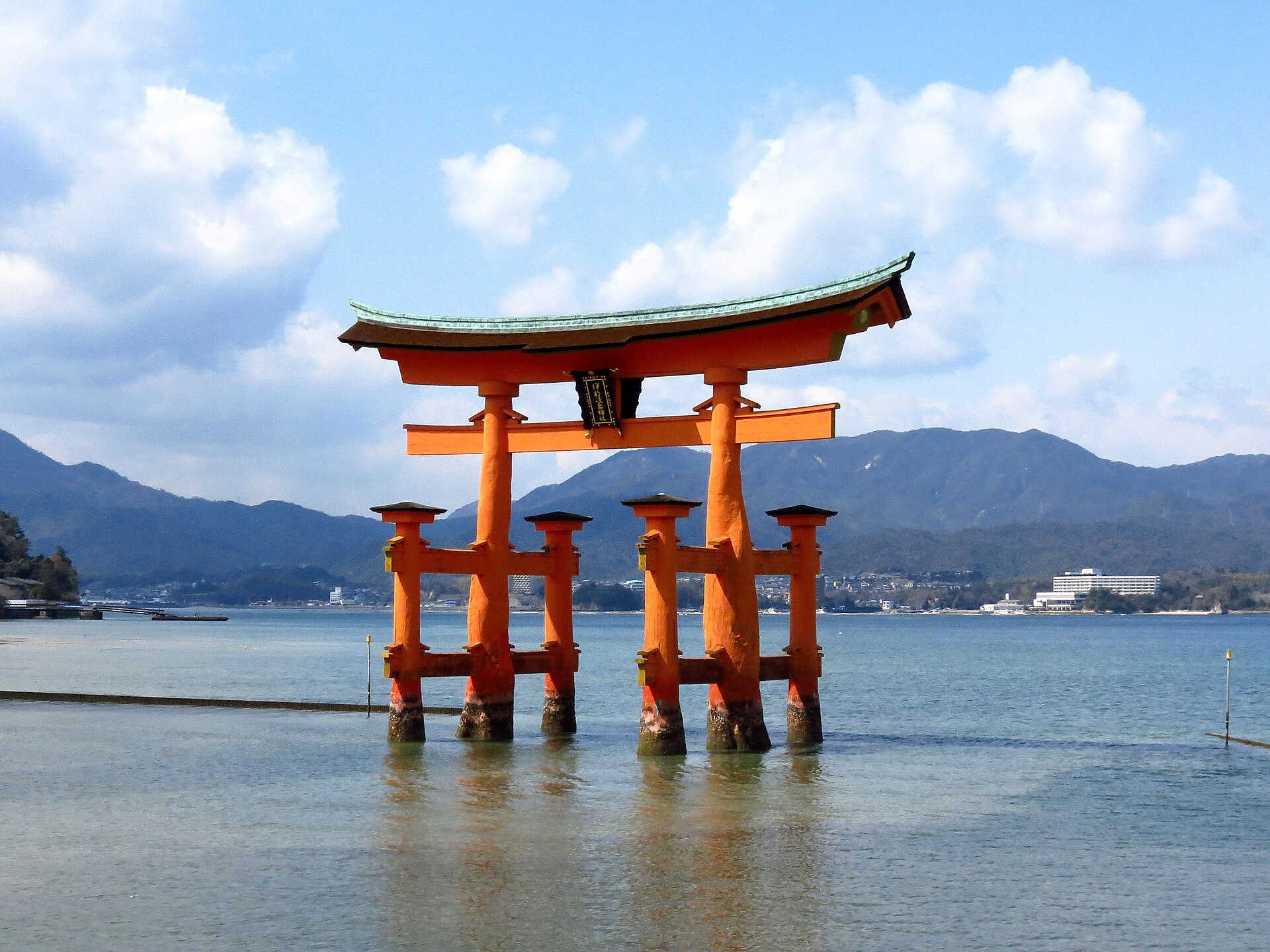

From the ferry rail it looks almost weightless: a slash of orange standing in grey-green water, too far from shore to belong to anything. Then the boat swings toward Miyajima and the rest of the composition arrives. Behind the gate, a long, low shrine of vermilion corridors sits on stilts over the bay, and behind that the island rises in a dark wall of forest to the summit of Mount Misen. Few places in Japan are so completely a single picture.
Itsukushima is the shrine's name and, formally, the island's too, though almost everyone calls the island Miyajima, the shrine island. It lies a short crossing off the coast southwest of Hiroshima, in the calm, island-studded waters of the Seto Inland Sea. Edo-period scholars counted the view among the Three Views of Japan, alongside the pine islets of Matsushima and the sandbar of Amanohashidate, and it has drawn pilgrims and sightseers in their thousands ever since. Come anyway. The crowds thin by evening, and the tide does not care who is watching.
The storyA shrine that would not touch the island
Tradition dates the first shrine here to the late sixth century, but the building you see owes its form to Taira no Kiyomori, the warrior-statesman who governed the province of Aki in the twelfth century and poured his clan's fortunes into Itsukushima. He rebuilt it in the elegant shinden manner of Heian aristocratic houses: halls joined by open corridors, cypress-bark roofs, everything lacquered a vermilion that glows against the water. The shrine is dedicated to three sea goddesses, daughters of the storm god Susanoo, protectors of sailors in an inland sea that was once Japan's great highway.
The island itself was held to be divine, so the shrine stands not on it but over the shallows, its boardwalks resting on pillars driven into the seabed. The floors are laid with small gaps between the planks, so that a storm surge can rise through them rather than lift the halls away. It is a building designed to be partly submerged, and it has survived centuries of typhoons by giving way at the right moments.
The Great Torii, the Ōtorii, stands some two hundred metres out in the bay. The present gate dates from the Meiji era and is the latest in a long line of replacements. Its two main pillars are trunks of camphor wood, braced by four smaller legs, and it is not sunk into the seabed at all. It stands on its own considerable weight, as it has through every storm since. The whole complex was inscribed as a UNESCO World Heritage Site in 1996.
It is a building designed to be partly submerged, and it has survived centuries of typhoons by giving way at the right moments.— On the corridors at high water
The walkHigh water, low water
Everything here depends on the tide, and the best visits are planned around it. At high water the corridors seem to float, the vermilion doubled in the sea beneath them, and the torii stands alone with the water lapping at its pillars. Six hours later the bay drains to wet sand and the gate is suddenly something you can walk up to, barnacles crusting its feet, coins pressed into the cracks of its camphor legs by visitors who came before you. Neither state is the better one. Try to see both.
Inside, the route runs one way along the corridors, past the main sanctuary and alongside a Noh stage that stands, like everything else here, over the sea. The hirabutai, a broad platform projecting toward the torii, is where the classic frontal view lines up: gate, water and mainland hills stacked one behind another. Pause there. The boards are worn silver underfoot, and on a still day you can hear the water moving beneath you.
The island repays a longer stay than the shrine alone. Tame sika deer wander the seafront, regarded as messengers of the gods, and will investigate any paper bag within reach. Omotesandō, the shopping street, smells of grilled oysters from the surrounding bay and of momiji manjū, small maple-leaf cakes filled with bean paste, baked in rows behind shop windows. Above town, Daishō-in temple climbs the slope in stone stairs and statuary, and Mount Misen offers a long forest walk or a ropeway toward a summit with views across the scattered islands of the Inland Sea.
Through the yearWhen to go
Spring
Cherry trees soften the shoreline and the hillside behind the shrine. Mild weather makes this the most comfortable season for climbing Misen.
Summer
Humid and bright, with the vermilion at its most saturated. The Kangen-sai festival brings courtly music onto decorated boats in the bay.
Autumn
Momijidani, the maple valley behind the shrine, turns to flame. The island's busiest season, and its most beautiful.
Winter
Cold, clear and quieter. Oyster season is at its height, and the low sun turns the gate copper in the late afternoon.
Know before you goPractical notes
- Check the tide table. Tide times are published for Miyajima and change daily. Plan your arrival so that you catch both a high and a low tide if you can.
- Stay the night. Most visitors leave on the late-afternoon ferries. An evening and early morning on the island, at a ryokan along the shore, is a different and far quieter place.
- Mind the deer. They are wild animals and expert thieves of maps, tickets and snacks. Keep food zipped away and do not feed them.
- Watch your footing at low tide. The sand around the torii is soft and the water returns faster than it seems. Wear shoes you do not mind getting wet.
- Leave time for Misen. Even a partial climb through the forest gives you the shrine and bay from above, and a sense of the island as more than its famous gate.