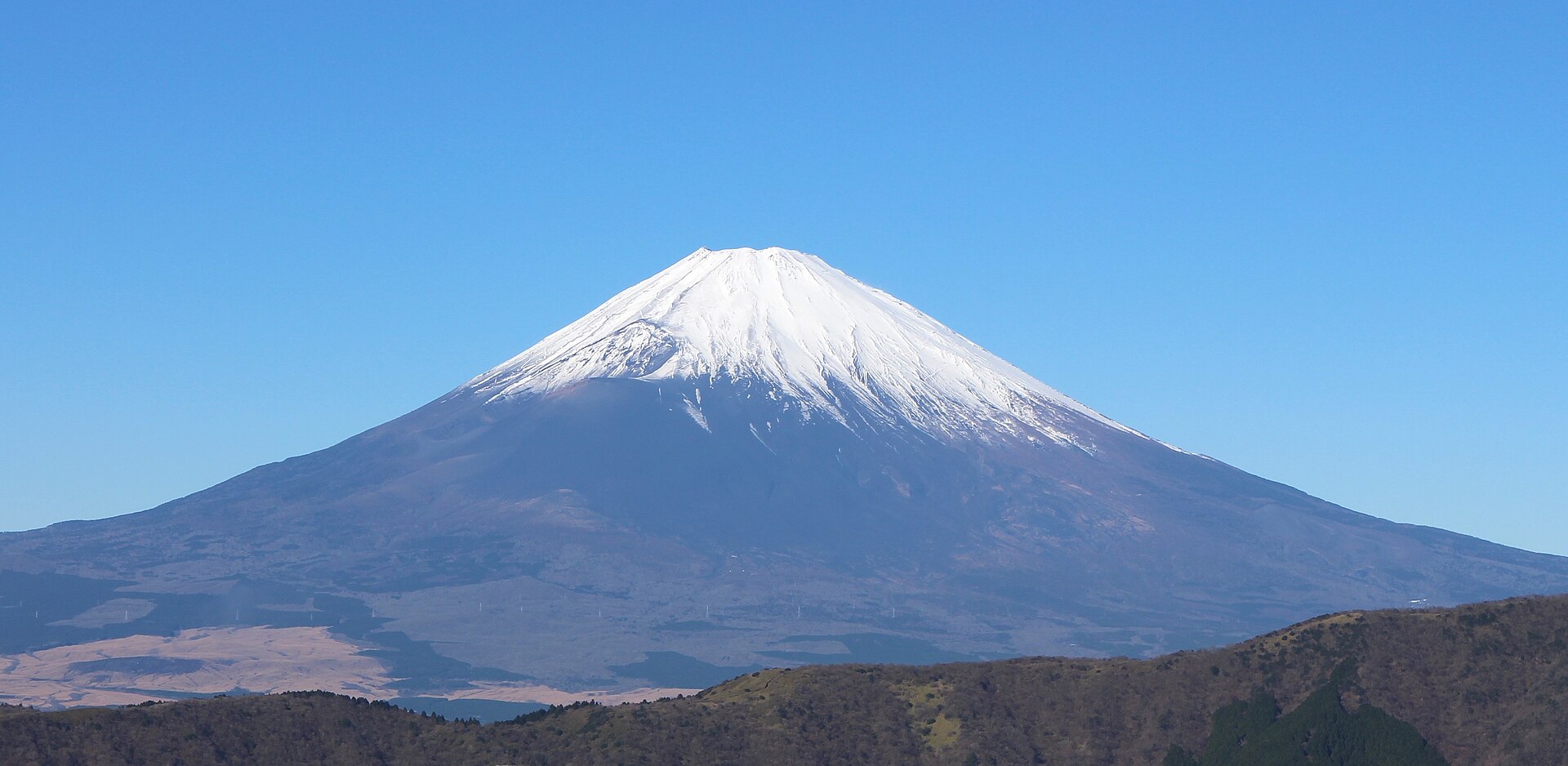

You will spend a good part of any trip to Fuji not seeing it. Cloud gathers on its flanks by mid-morning, haze softens it to a rumour, and whole days pass with the mountain present only as a direction people point in. Then the air clears, usually early and usually in the cold months, and there it is: 3,776 metres of near-perfect symmetry, white at the crown, standing alone above the plain as if someone had set it down there on purpose.
That solitude is the secret of its power. Fuji has no range to hide in. It rises from close to sea level on the border of Yamanashi and Shizuoka, so that on a clear winter day it can be seen from the upper floors of Tokyo, more than a hundred kilometres away. Few mountains this tall are this easy to read. The eye travels up one long, concave slope, pauses at the flattened summit, and comes down the other side, and the shape stays with you in a way that jagged peaks never quite manage.
The storyA volcano, a goddess, a print
Fuji is an active stratovolcano, built up in layers over many thousands of years. Its last eruption, in 1707, came during the Edo period and dusted the streets of the shogun's capital with ash. The scar of that event, the Hōei crater, still bites into the mountain's southeastern flank, which is the face you see from Hakone and Gotemba. The mountain has been quiet since, though the hot springs, steaming vents and lava fields around its base are reminders that quiet is not the same as asleep.
Long before anyone measured it, Fuji was worshipped. Sengen shrines ring its foot, dedicated to Konohanasakuya-hime, the Shintō goddess associated with the mountain, and the grandest of them, Fujisan Hongū Sengen Taisha in Fujinomiya, regards the summit itself as part of its sacred precinct. Pilgrims in white once climbed in organised confraternities, chanting as they went, and the practice of ascending the mountain as an act of devotion shaped the trails that hikers still use.
Then came the artists. Hokusai's Thirty-six Views of Mount Fuji and Hiroshige's later series turned the peak into a recurring character: tiny and distant behind a great wave, glowing red at dawn, glimpsed between barrels and bridges and rice fields. It is largely through these woodblock prints that the world learned what Japan looks like. In 2013 UNESCO inscribed Fujisan as a World Heritage Site, not for its geology but as a sacred place and a source of artistic inspiration, which is exactly right.
That solitude is the secret of its power. Fuji has no range to hide in.— From the Hakone side
The viewWhere to stand
Most travellers meet Fuji from one of two directions. To the north lie the Fuji Five Lakes, with Kawaguchiko the busiest and best served. Here the mountain fills the sky across open water, and on still mornings it doubles in the lake. Climb the steps above Arakurayama Sengen Park to the five-storey Chūreitō pagoda and you get the composition every tourism poster seems to borrow: red pagoda, town below, Fuji floating beyond.
To the southeast is Hakone, where this photograph was taken. The approach is wilder and more volcanic. At Ōwakudani, a valley of sulphur vents and yellow-stained rock formed by an ancient eruption of the Hakone volcano, the ground hisses and the air smells of struck matches. Eggs boiled in the hot springs come out with black shells, and on a clear day the whole of Fuji's southeastern face stands over the ridge, dark at the base and white above, close enough to trace the gullies in the snow.
Climbing is another matter entirely. The mountain opens to hikers only in the short summer season, when the snow has gone and mountain huts along the trails take in walkers. Four main routes lead up from the fifth stations: Yoshida, Subashiri, Gotemba and Fujinomiya. Many people climb through the night to reach the crater rim for sunrise, known as goraikō. It is a hard, gritty, crowded walk on loose volcanic scree, closer to a pilgrimage than a pleasure hike, and the reward is not the mountain's beauty but the strange privilege of standing on it.
Through the yearWhen to go
Spring
Cherry blossom frames the mountain around the lakes, though spring haze often veils it by midday.
Summer
The climbing season. Fuji loses most of its snow and hides behind cloud for days; the view is rarer, the summit busier.
Autumn
The first snow returns to the cap, maples redden along the lake shores, and clear days grow more frequent.
Winter
The best season for seeing Fuji. Dry, cold air brings sharp mornings and a full white crown, as in the photograph above.
Know before you goPractical notes
- Go early. Fuji is most often clear at first light and tends to cloud over as the day warms. Plan your viewpoint for the morning, not the afternoon.
- Keep the plan loose. If you can, stay a night near the lakes or in Hakone so you have two chances at a clear sky rather than one.
- Respect the climbing season. Outside summer, the upper mountain is a serious winter environment with no huts open. Climbing then is for experienced, properly equipped mountaineers only.
- Take altitude seriously. The summit is high enough to cause altitude sickness. Climbers who rest at a hut on the way up, rather than rushing to the top overnight, usually fare better.
- Pack for cold. Even on a summer night the crater rim can be near freezing, with strong wind. Bring warm layers, gloves and a headlamp.