
Most of Japan's sacred architecture argues for restraint: bare timber, raked gravel, the beauty of what is left out. Tōshō-gū argues the opposite, and wins. Here, a couple of hours north of Tokyo in the mountains of Tochigi, the Tokugawa shoguns built a resting place for the founder of their dynasty and covered it in everything they had: black lacquer, vermilion, gold leaf, and thousands of carved and painted creatures.
What saves it from gaudiness is the setting. The shrine climbs a wooded slope in a series of terraces, and the cedars around it are so tall and so old that the buildings sit in a kind of green dusk. Colour that would shout in a city square here seems to glow quietly, like embroidery seen by lamplight. Come prepared to look closely, and to look up.
The storyA god made of a general
Tokugawa Ieyasu, the warlord who ended more than a century of civil war and founded the shogunate that would rule Japan until 1868, died in 1616. In keeping with his wishes he was enshrined at Nikkō, a mountain place long sacred to both Shintō and Buddhist practice, and deified as Tōshō Daigongen, the great avatar who illuminates the east.
The first shrine was modest. It was Ieyasu's grandson, the third shogun Iemitsu, who transformed it, ordering a sweeping reconstruction completed in 1636. Craftsmen were drawn from across the country, and the result was less a building than a statement: the Tokugawa were permanent, and their founder was a god. Daimyō were expected to contribute, and one lord, unable to match the gifts of richer rivals, offered instead to plant cedars along the approach roads. Those trees, now the famous Cedar Avenue of Nikkō, have outlasted most of the gifts.
Tōshō-gū, along with the neighbouring Futarasan-jinja and Rinnō-ji, was inscribed as a UNESCO World Heritage Site in 1999 under the title Shrines and Temples of Nikkō. The old mingling of Shintō and Buddhism survives in the fabric itself, most obviously in the five-storey pagoda that stands inside the shrine grounds near the entrance.
Colour that would shout in a city square here seems to glow quietly, like embroidery seen by lamplight.— Beneath the cedars
The walkGate by gate, up the mountain
The approach is a lesson in pacing. A broad stone path rises through the trees to a great granite torii, the pagoda glowing red off to one side, and then into the first courtyard, where the storehouses carry carvings of elephants drawn by an artist who had evidently never seen one. On the Sacred Stable, a plain building that houses the shrine's white horse, runs a frieze of monkeys acting out the stages of a life. One panel among them, three monkeys covering eyes, ears and mouth, is the most famous rendering of an image now known around the world.
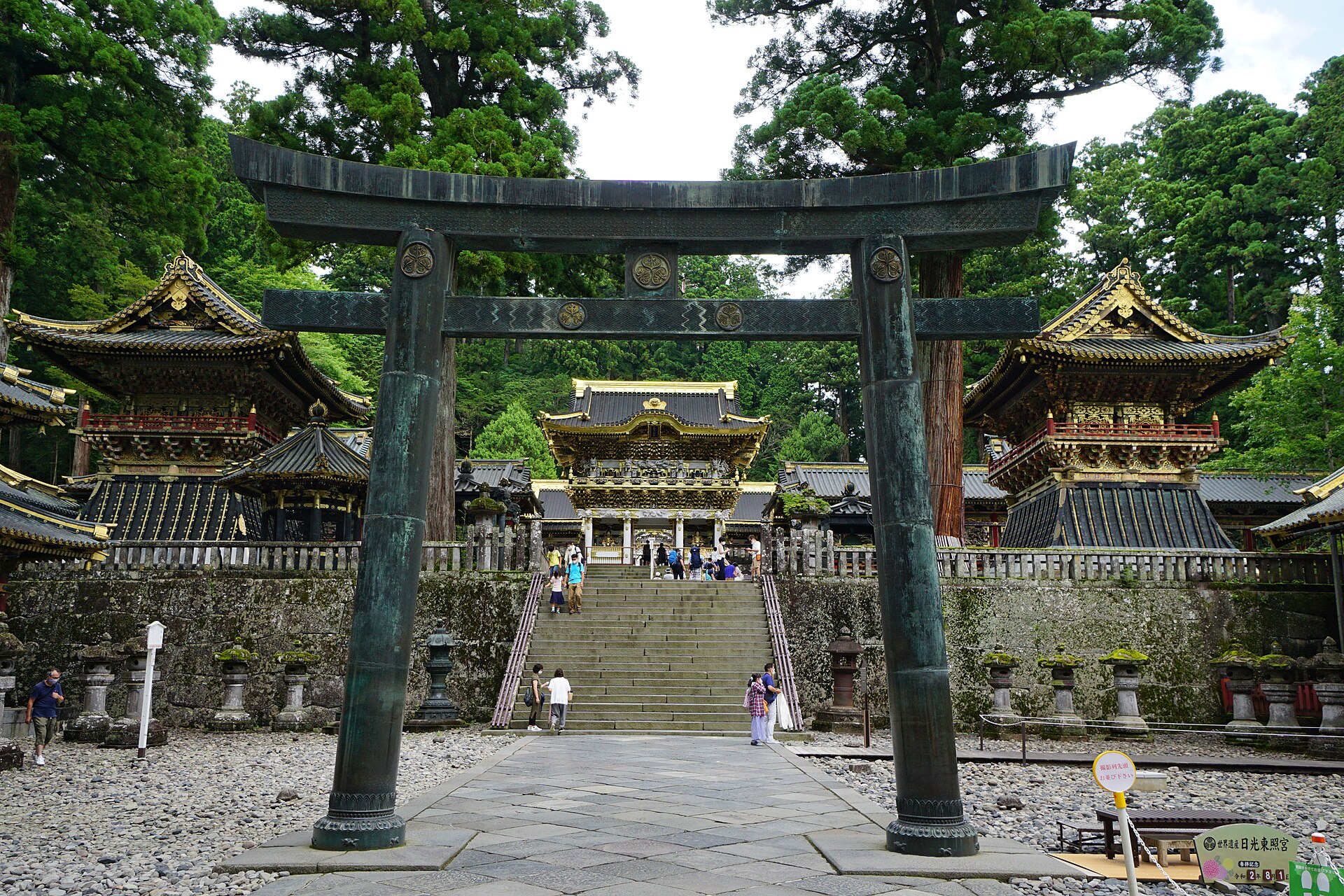
Then comes the view in our photograph: a bronze torii stamped with the triple hollyhock crest of the Tokugawa, stone lanterns furred with moss, a broad flight of stone steps, the bell and drum towers on either flank, and at the top, Yōmeimon. This is the shrine's masterpiece, a two-storey gate so densely carved with sages, children, dragons and mythical beasts that it earned the nickname Higurashi-no-mon, the gate you could gaze at until the sun goes down. Its white columns are covered in a fine swirling pattern, and on one of them the pattern runs upside down, a deliberate flaw said to ward off the bad luck of perfection.
Beyond it lie the Karamon gate and the main sanctuary, and to the side a small passage marked by the Sleeping Cat, a carving traditionally attributed to the craftsman Hidari Jingorō. On its reverse, sparrows play unafraid. From here a long stone stairway of some two hundred steps climbs through the cedars to Ieyasu's tomb, a small bronze pagoda in a quiet enclosure. After the uproar of colour below, the plainness up here is the point.
Through the yearWhen to go
Spring
Cherry blossom comes late at this altitude, and in May the grand festival brings a procession of costumed samurai through the cedars.
Summer
Cooler than Tokyo and deeply green; mist and passing rain make the lacquer shine and the moss glow.
Autumn
The mountains above Nikkō turn crimson, and the procession returns in October. Expect crowds on the roads.
Winter
Snow on gold-trimmed roofs, thin crowds and a clear, cold light. Dress for the mountains, not the city.
Know before you goPractical notes
- Arrive early. The tour coaches from Tokyo build through the morning. The first hour of the day gives you Yōmeimon with room to stand back and look.
- Wear proper shoes. Gravel, uneven stone and the long climb to the inner tomb make this a walk as much as a visit.
- Shoes off in the sanctuary. You will remove them to enter the main hall; socks you are happy to be seen in are worth packing.
- Look up and look small. The best carvings are often the least obvious. Bring patience, and binoculars if you have them.
- Make a day of Nikkō. Futarasan-jinja, Rinnō-ji and the vermilion Shinkyō bridge are all within walking distance, and Lake Chūzenji lies higher up the mountain road.