
The ferry slows, the engines drop to a murmur, and the first thing you see on the quay at Miyanoura is a giant red pumpkin, dotted black and big enough to walk inside. It is a fitting welcome. Naoshima is a quiet island of fishermen and pine-covered hills, a short crossing from the mainland, and over the past few decades it has become one of the most persuasive places on earth to look at contemporary art.
What makes it persuasive is not the quantity of work but the setting. Paintings, sculptures and whole rooms of light sit among small harbours, terraced hillsides and beaches where the water barely moves. You walk, or cycle, from one to the next with salt on the air, and somewhere between the museums the boundary between what was made and what was simply there begins to blur.
The storyFrom smelter island to art island
For most of the twentieth century Naoshima was known for something else entirely. A copper smelter opened on its northern shore in the 1910s and still operates there, and the island's population, like that of many in the Inland Sea, thinned as younger people left for the cities. The turn came in the late 1980s, when the Fukutake family, whose education publisher is now known as Benesse, set out to build a place where art, architecture and nature could meet on equal terms.
They brought in the Osaka architect Tadao Ando, and his smooth, almost liquid concrete now defines the island's southern coast. Benesse House, a museum and hotel under one roof, opened in 1992. The Chichu Art Museum followed in 2004, set almost entirely underground so that it would not interrupt the line of the hill. Inside, daylight falls from above onto Claude Monet's late water lilies, onto a vast granite sphere by Walter De Maria, and into James Turrell rooms where the edges of space seem to dissolve. The Lee Ufan Museum, another Ando collaboration, added a meditative counterpoint in 2010.
The project did not stay sealed inside galleries. In the old village of Honmura, artists were invited to rework empty houses, a shrine and a former dentist's surgery, and the Art House Project spilled art into the lanes where people still hang their washing. Since 2010 the Setouchi Triennale has carried the idea across a scatter of neighbouring islands, and Naoshima has become the anchor of the whole region's reinvention.
Somewhere between the museums, the boundary between what was made and what was simply there begins to blur.On the coast road
The walkAn island at walking pace
The island is small enough to understand in a day and rewarding enough to deserve two. From Miyanoura, with its airy SANAA ferry terminal and Shinro Ohtake's riotous bathhouse, I♥湯, a road winds south over the hills to the Benesse area. Here the art begins to leak out onto the shoreline: sculptures on the grass, a photograph series by Hiroshi Sugimoto that sets the horizon of the sea against the horizon of the image, and at the end of a small concrete pier, Yayoi Kusama's yellow pumpkin, the island's most photographed object.
Go to the Chichu Art Museum with time and patience. The approach passes through a garden planted to echo the flowers in Monet's paintings, and then the building swallows you. Corridors of bare concrete open into courtyards of crushed stone, and the light shifts with every cloud, so a room seen in the morning is not quite the room seen in the afternoon. Visitors lower their voices without being asked.
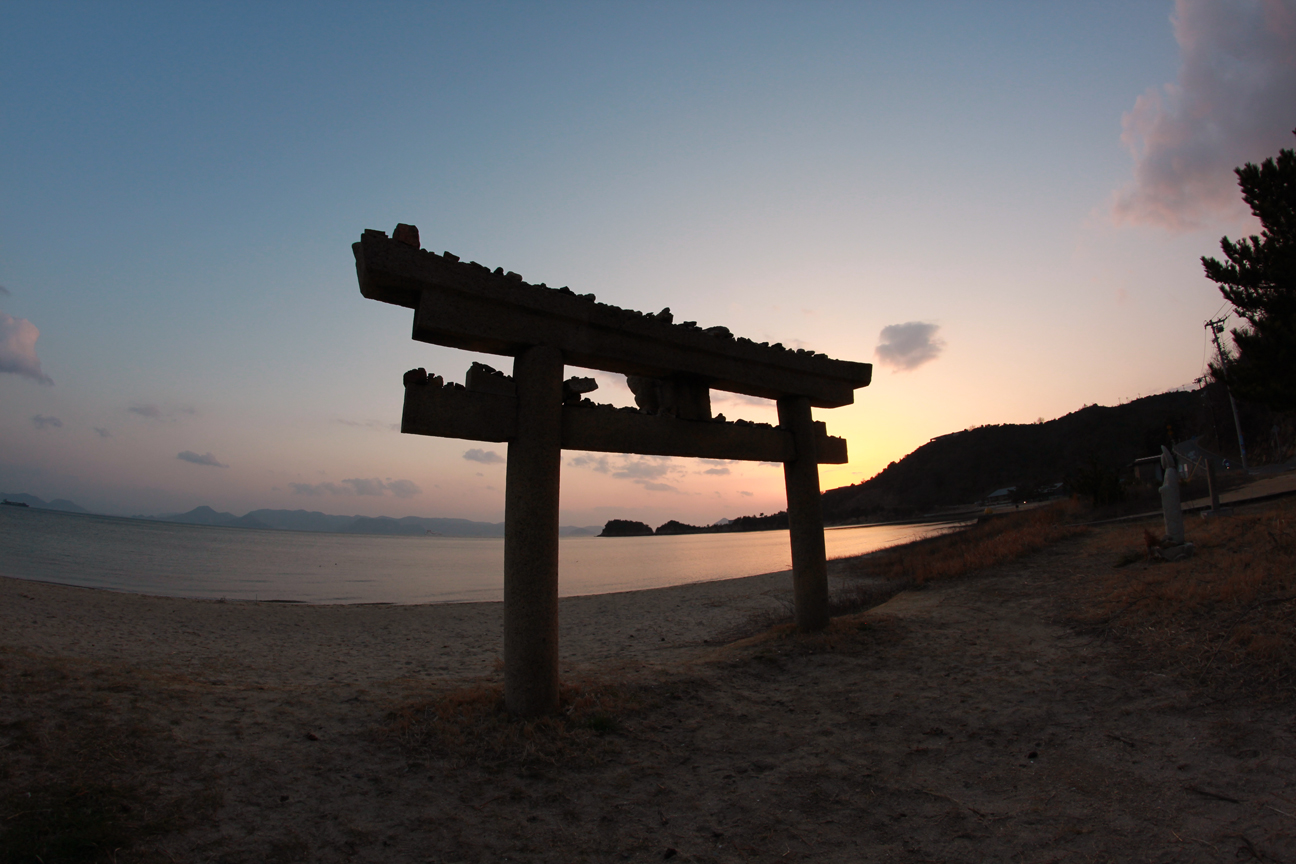
Then find the ordinary island. Honmura's lanes of charred cedar walls and tiled roofs are lovely in themselves, and between the Art Houses there are small shrines, potted plants and dyed noren curtains stirring in the doorways. On the quieter beaches, like the one in our photograph, a simple stone torii stands near the waterline, its crossbeams heaped with pebbles that passers-by have tossed up for luck. As the light goes, it reads as a silhouette, and you realise that the island's oldest gestures and its newest ones are speaking the same language.
Through the yearWhen to go
Spring
Soft light, mild air and cherry blossom on the hillsides make this the ideal season for cycling between museums.
Summer
Hot and humid, with long evenings and warm water for a swim off the southern beaches. Start early and rest at midday.
Autumn
Clear skies over the Inland Sea and crisp sunsets. In Triennale years the islands are lively but busy.
Winter
Quiet and luminous, with low sun raking through Ando's concrete. Some of the island's most contemplative days.
Know before you goPractical notes
- Book the Chichu ahead. Entry is by timed reservation, and slots sell out on busy days. Plan the rest of your route around it.
- Check closing days. Most of the island's museums share a regular weekly closing day, so confirm before you sail rather than arrive to locked doors.
- Rent a bicycle. The island is hilly but compact, and electric-assist bikes from near the port make the climbs easy. A local bus also links the main areas.
- Stay overnight if you can. Once the last day-trippers sail, the coast falls silent, and a guest at Benesse House can see the galleries in a gentler light.
- Respect the village. Honmura is a living neighbourhood, not a set. Keep your voice down and your camera away from front doors.