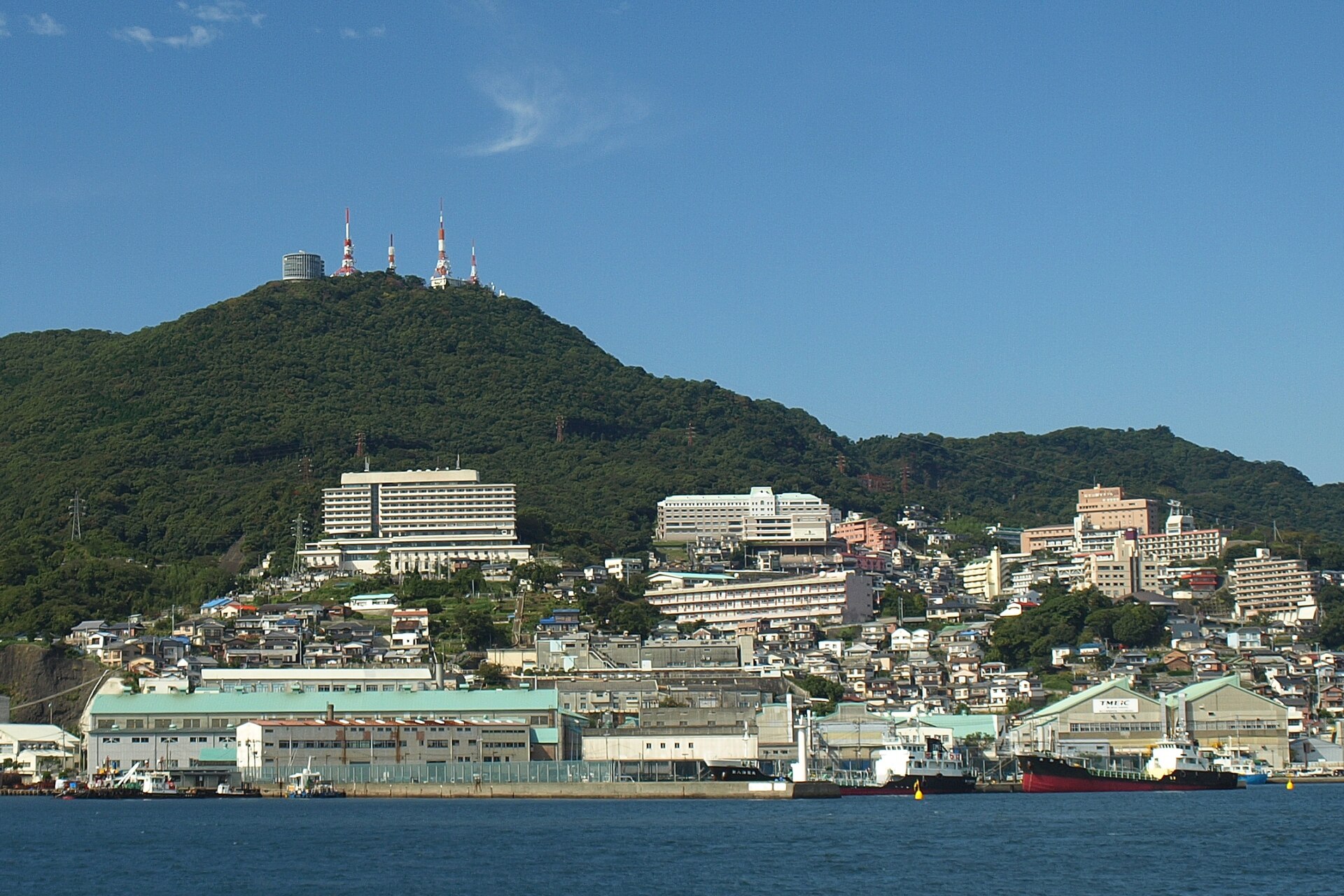

From the water, Mount Inasa looks almost domestic. A rounded green hill, a cluster of red-and-white transmitter masts on top, a drum-shaped building beside them, and below that a tide of hotels, apartment blocks and tiled roofs that runs down to the warehouses and moored freighters of the western quay. It is only when you stand on the summit, with Nagasaki laid out across the harbour like an open hand, that you understand why the city keeps sending visitors up here.
Inasa rises a little over three hundred metres on the west side of Nagasaki Harbour, directly opposite the old town. That modest height is exactly right. High enough to take in the whole sweep of the port, the long inlet that runs out to the East China Sea, and the hills that wrap around the city on three sides; low enough that the streets below never shrink to abstraction. You can pick out a tram crawling along the waterfront, a ferry turning in its own wake, the pale bulk of a ship in dry dock.
The storyA port that built itself uphill
Nagasaki has always been a harbour first and a city second. The deep, sheltered inlet drew Portuguese traders in the sixteenth century, and through the two centuries when Japan kept the outside world at arm's length, the small artificial island of Dejima, here in this same bay, was the country's narrow window onto Europe. Dutch ships, Chinese junks, Western merchants on the slopes of Ōura: the city's character was shaped by what came in on the water.
What it lacked was flat ground. Nagasaki is squeezed between the harbour and a ring of steep hills, and so the town climbed. Houses, temples, schools and cemeteries were terraced up slopes so sheer that many lanes are stairways, and the result, seen from across the water, is a city arranged almost vertically, like seating in an amphitheatre. Mount Inasa is the stage it faces.
That geography is the whole secret of the view. In a flat city, lights spread out in a thin carpet; here they are stacked in tiers, row above row, folding into valleys and running along ridgelines until they stop abruptly where the forest begins. After dark, the harbour becomes a black ribbon through the middle of it all, edged with the brighter glare of the shipyards. Nagasaki's night view is ranked among the finest in Japan, and the city is justifiably proud of it.
In a flat city, lights spread out in a thin carpet; here they are stacked in tiers, row above row.— On the summit deck
The ascentUp through the trees
Most people go up by ropeway. The lower station sits beside Fuchi Shrine on the harbour's western side, and the gondola lifts out over the shrine roofs and the treetops, the city swinging slowly into view behind you as you rise. It is a short ride and a good one: sit facing back toward the water if you can. There is also a road to the summit, and a small slope car that climbs from the parkland lower down, so the top is within reach even for those who would rather not dangle.
The summit is a compact, well-tended place. The round observation building you can see from the harbour has a glass-walled interior and an open rooftop deck, and the paths around it are lit after dark with soft lights set into the ground so that nothing competes with the view. On the far side, away from the city, the land falls toward the open sea, and on a clear afternoon the coast fades west into a scatter of islands and haze.
Below the summit, the slopes are a city park, threaded with walking paths through mixed forest. If you have time and decent shoes, walking down rather than riding is a fine way to end the evening, the lights of Nagasaki appearing and disappearing between the trees.
Through the yearWhen to go
Spring
Azaleas colour the parkland on the lower slopes, and the evenings are mild enough to linger on the open deck. Spring haze can soften the distance, so the city reads better than the sea.
Summer
Long, humid days and late sunsets. Afternoon storms often clear the air, and the hour after rain is when the lights look sharpest.
Autumn
Settled weather and clearer skies. In early October the city below is loud with Kunchi, the great festival of Suwa Shrine, and the evenings up top are cool and still.
Winter
The crispest air of the year, and the most brilliant night views. Around the Lunar New Year, the Lantern Festival hangs thousands of lanterns through the old town. Dress for the wind.
Know before you goPractical notes
- Arrive before sunset. The real show is the change from day to night, so aim to be on the deck while the sky is still bright and stay until it is fully dark.
- Check the sky, not just the forecast. Low cloud can sit on the summit while the city below is clear. If the masts are lost in mist from the harbour, wait for another evening.
- Bring a layer. The top is exposed and the wind off the sea is cooler than you expect, even in summer.
- Steady your camera. The rooftop deck has rails and ledges that serve as a makeshift tripod; turn off your flash and let the city do the lighting.
- Expect company. Clear weekend evenings draw crowds to the ropeway. Going on a weeknight, or staying past the first wave of sunset visitors, buys you more room.