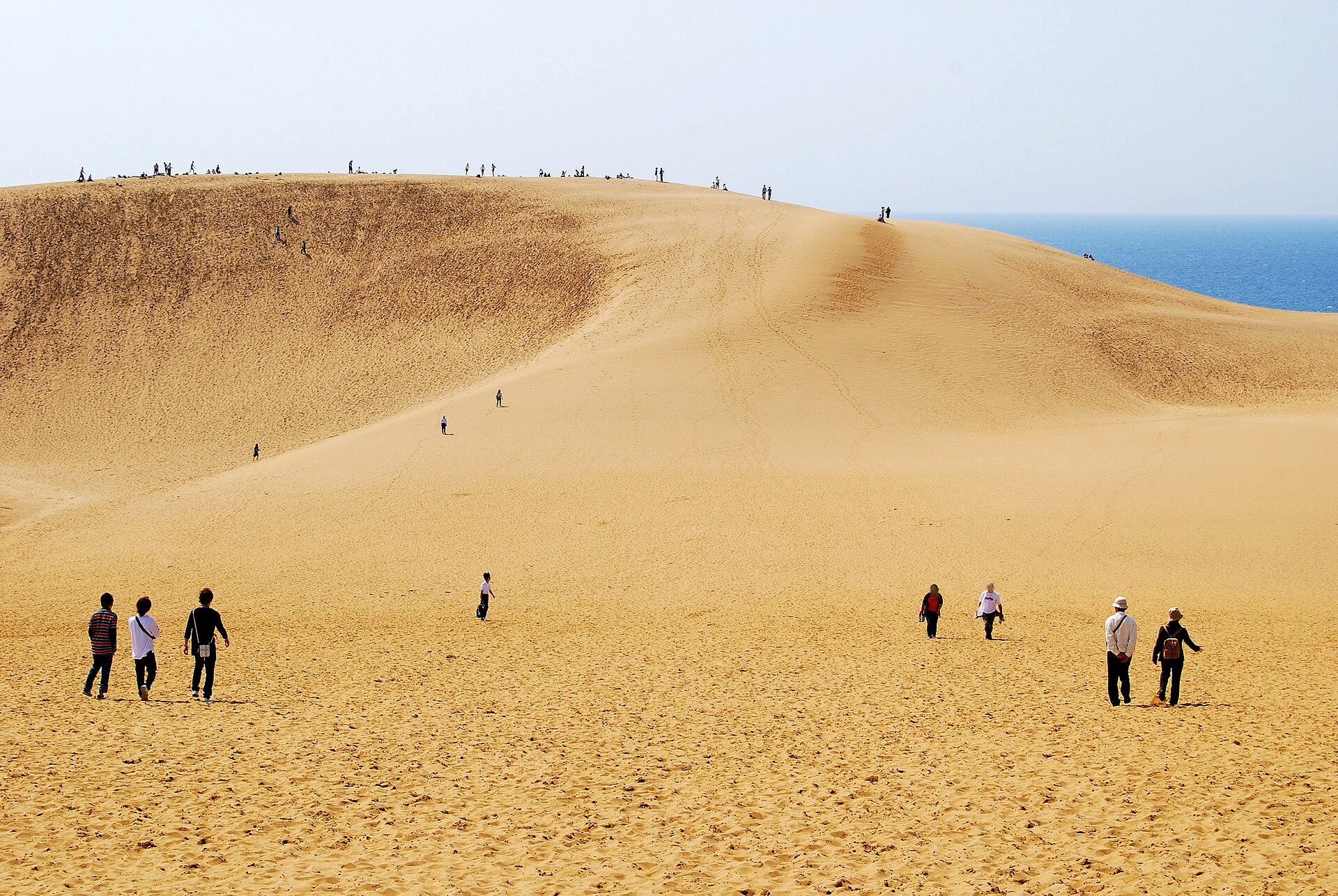

Japan is a country of mountains, rice terraces and crowded coasts, so the first sight of Tottori's dunes comes as a jolt. Step off the bus, walk through a thin belt of pines, and the ground turns to pale gold and rises ahead of you in one long, bare slope. Figures on the crest look like punctuation. Somewhere beyond them, out of sight, the Sea of Japan is breathing.
This is the Tottori Sakyū, the most celebrated of Japan's coastal dunes, stretching for roughly sixteen kilometres along the shore just north-east of the prefectural capital and more than two kilometres deep at its widest point. It is not a desert, and the locals are quick to say so: the climate is damp, the winters are snowy, and the sand is held in a constant negotiation between wind, water and the grasses that would happily cover it. That is exactly what makes it worth the journey to one of the quietest corners of Honshū.
The storySand from the mountains, shaped by the sea
The dunes begin far inland. For tens of thousands of years the Sendai River has carried weathered granite down from the Chūgoku Mountains and dumped it at the coast. Currents spread that sediment along the shore, and the northwesterly winds that sweep across the Sea of Japan in winter pick it up and pile it inland, layer over layer. Beneath the loose surface lie older, darker strata of volcanic ash, a record of eruptions long before anyone walked here.
The result is a landscape that never quite holds still. On a windy morning the surface is combed into fūmon, fine parallel ripples as regular as the lines in a raked temple garden. Where the wind funnels down a steep face, sand slides in thin curtains called suren. In late winter and spring a shallow pool, known simply as the Oasis, often forms in the hollow at the foot of the great ridge, fed by groundwater and snowmelt, and then drains away again by summer.
The dunes are protected as a national natural monument and sit within the San'in Kaigan National Park and the UNESCO Global Geopark of the same name. Protection here means something unusual: not keeping people out, but keeping plants from taking over. After pine plantations and farming were introduced along the edges in the twentieth century, vegetation began creeping across the open sand, and volunteers now turn out regularly to pull weeds by hand so the wind can keep doing its work.
Artists noticed the place early. The photographer Shōji Ueda, a son of Tottori Prefecture, staged his famous surreal portraits on these slopes, arranging family members like chess pieces against an empty horizon. Kōbō Abe's novel The Woman in the Dunes is often linked with Tottori in the popular imagination, and you will understand why after an hour of sand in your shoes.
At the crest the land simply ends, and the sea arrives all at once, enormous and blue.— On the Uma-no-se ridge
The walkUp the horse's back
Most visitors make for one destination: the Uma-no-se, or "horse's back," the long ridge that rises between the inland hollow and the sea. It stands roughly forty-seven metres high, and from the bottom it looks like a modest stroll. It is not. The sand gives under every step, your calves start to complain halfway up, and the slope is steeper than it appears. People zigzag, stop, laugh at one another, and keep going.
The reward is instantaneous. At the crest the land simply ends, and the sea arrives all at once, enormous and blue. The far side of the ridge drops away to a wide beach and the open Sea of Japan, usually a deeper colour than you expect. People sit along the top in loose rows, shoes off, saying very little. Some run straight back down the inland face in long, plunging strides that are one of the purest small pleasures in Japan.
Beyond the ridge there is more to do if you want it. Camel rides plod along the inland flats, a slightly absurd and entirely charming sight. Sandboarding and paragliding outfits use the slopes when the wind allows. Near the main entrance, the Sand Museum mounts a new exhibition of monumental sand sculptures each year, built by international sculptors around a single country or theme and then left to crumble back into the dune when the show ends.
Tottori itself repays an evening. In winter the port towns along this coast are known for matsuba-gani, the local snow crab, and in late summer the prefecture's famous Nijisseiki pears appear in every shop. On the sandy farmland just east of the dunes, fields of rakkyō, a small pickling shallot, turn purple with flowers in autumn.
Through the yearWhen to go
Spring
Mild air and clear light make this the classic time for the climb. The Oasis is often at its fullest, mirroring the ridge above it.
Summer
The sand absorbs the sun and grows genuinely hot underfoot by midday. Come early or late, when the light rakes across the ripples.
Autumn
Steady winds draw the sharpest ripple patterns of the year, and the crowds thin. Rakkyō flowers colour the fields nearby.
Winter
Snow sometimes dusts the dunes, turning them into something closer to a polar landscape. Wrap up: the sea wind is fierce.
Know before you goPractical notes
- Footwear matters. Sand gets into everything. Wear shoes you do not mind filling, or carry them and go barefoot when the sand is cool.
- Pace the ridge. The Uma-no-se climb is short but tiring. Zigzag, rest, and leave energy for the walk back across the hollow.
- Mind the sun and wind. There is no shade on the dunes. Bring water, a hat and sunglasses; on windy days blowing sand stings and finds its way into camera bags.
- See it from above first. The raised viewpoint on the inland hill behind the dunes gives a fine overview of the whole system before you descend into it.
- Leave the sand as it is. The dunes are a protected natural monument. Writing large messages in the sand is not permitted, and visitors are asked not to take sand away.