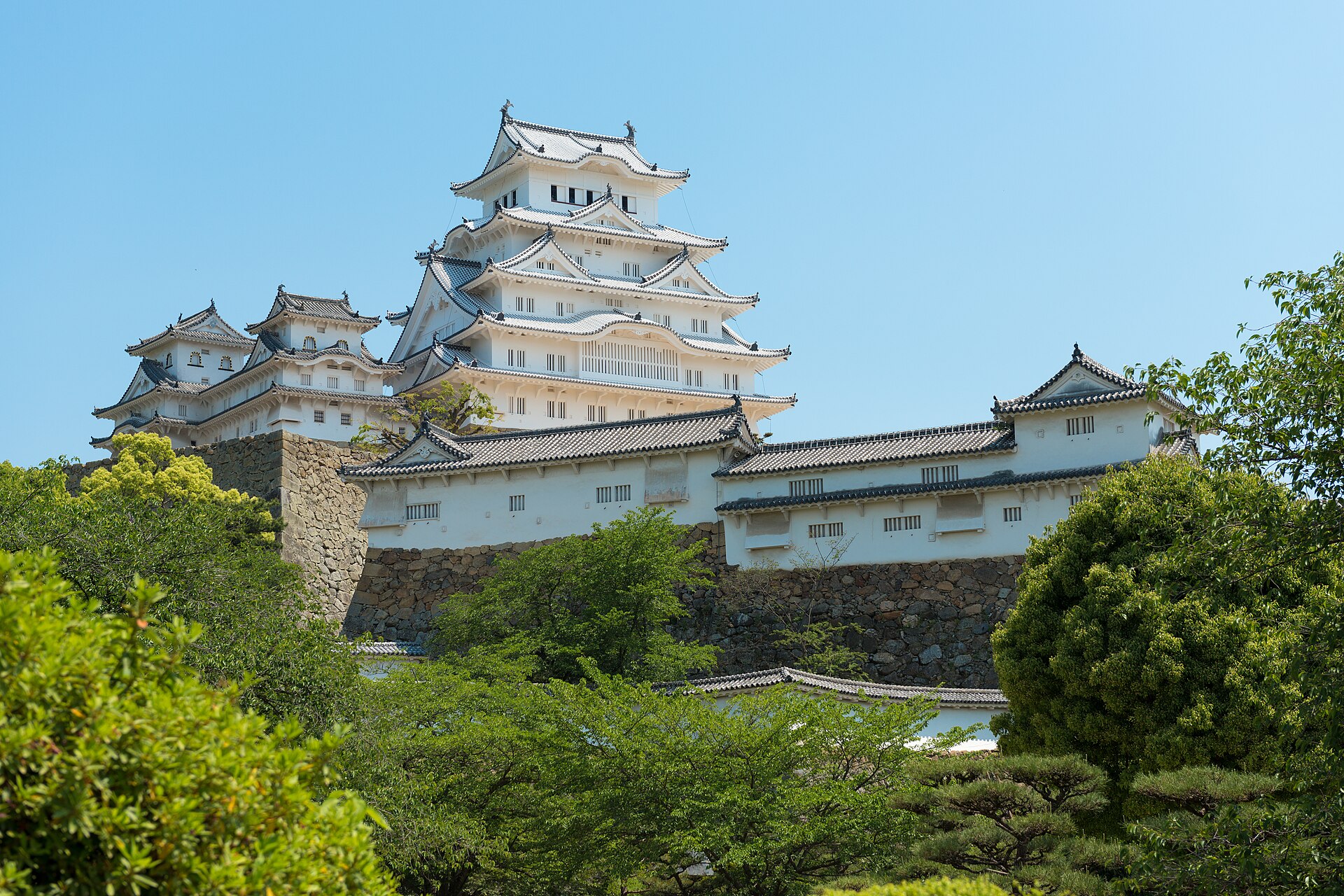

Step out of Himeji Station and the castle is already waiting for you, framed at the far end of a broad avenue, pale against the sky. It does not look like a fortress so much as a creature: tier upon tier of white gables lifting from a hill of grey stone, the roofs curling at their tips like folded wings. The Japanese call it Shirasagi-jō, the White Heron Castle, and once you have seen it, no other name seems right.
Japan has many castles, but most of the keeps you can climb today are postwar reconstructions in concrete. Himeji is the real thing. Its main keep has stood on this hill since the early seventeenth century, through earthquakes, the dismantling of feudal Japan and the firebombing of the city below in 1945. It was among the first places in the country to be inscribed as a UNESCO World Heritage Site, in 1993, and it is a National Treasure. More than any other building, it shows what a Japanese castle was meant to be.
The storyA fortress that never had to fight
There were fortifications on Himeyama hill as early as the fourteenth century, and Toyotomi Hideyoshi raised a three-storey keep here in the 1580s. But the castle you see is largely the work of Ikeda Terumasa, son-in-law of Tokugawa Ieyasu, who was granted the domain after the Battle of Sekigahara in 1600. Over the following decade he rebuilt it on a grand scale, completing the great keep around 1609. It was a statement as much as a defence: a Tokugawa ally holding the western approaches to the new shogun's realm.
A few years later the Honda family added the Nishi-no-maru, the western bailey, whose long corridor of rooms is tied to Princess Sen, granddaughter of Ieyasu, who lived here after her second marriage. The castle was never besieged. Its labyrinth of gates and walls was never tested, which is one reason so much of it survives in its original form.
That whiteness is not paint. The walls are finished in shikkui, a lime plaster that also served as fireproofing, and the roof tiles are sealed with the same white plaster along their joints, which is what gives the castle its silvered, almost frosted look. A long restoration of the main keep, completed in 2015, renewed the plaster and tiles; in the years just after, the building gleamed so brightly that locals took to calling it Shirosugi-jō, the castle that is too white.
It does not look like a fortress so much as a creature, white gables lifting from grey stone like folded wings.— From the Ōtemae avenue
The walkThrough the maze to the keep
The approach is designed to confuse. From the open lawn of the Sannomaru you pass through a sequence of gates, lettered in the old iroha order, along paths that double back, narrow, and turn away from the keep just when you expect to arrive. Look up and you will notice the walls are pierced with small openings in circles, triangles and squares: loopholes for muskets and bows, aimed at precisely the corners where an attacker would have been forced to slow down. The stone ramparts flare gently at their base and steepen as they rise, a profile that is both beautiful and very hard to climb.
Along the way there are stories set into the stonework. In one rampart sits an old millstone, said to have been donated by a poor widow when builders ran short of stone; elsewhere is the well linked to Okiku, the servant girl of the famous ghost tale, who is said to count plates in the dark. They are small, human details in a place built for war.
Inside the main keep, shoes come off and the climb begins. Five roofs outside conceal six floors and a basement within, joined by stairways steep enough to feel like ladders. The interiors are bare: polished floorboards, weapon racks on the walls, and two enormous wooden pillars running up through the building's heart. What you come for is the timber itself and the light slanting through the lattice windows. At the top, a small shrine sits under the roof beams, and the city spreads out to the hills and, on a clear day, toward the Inland Sea.
Through the yearWhen to go
Spring
The grounds hold hundreds of cherry trees, and white walls behind pink blossom is the castle's most famous picture. Expect crowds at their peak in early April.
Summer
The new leaves of May, seen in the photograph above, thicken into deep green that softens the ramparts. By midsummer the keep's upper floors grow close and warm, so climb early.
Autumn
Clear, dry air sharpens every edge of the roofline, and the maples in neighbouring Kōko-en turn crimson.
Winter
The quietest season. Low sun lays long shadows across the plaster, and on a cold blue day the keep looks carved from ice.
Know before you goPractical notes
- Walk from the station. The castle sits at the end of the main avenue from Himeji Station, and the stroll toward it, watching it grow, is part of the experience.
- Dress for stairs. You climb the keep in socks on smooth wooden steps. Wear shoes that come off easily and carry as little as possible.
- Go early. Tour groups arrive mid-morning, and the keep's narrow stairs become a slow queue. The first hour of the day is calmer.
- Pair it with Kōko-en. The walled gardens beside the castle's west moat were laid out on the site of old samurai residences and make a quiet coda to the climb.
- Find the outside views. The best views of the castle are from outside the walls: across the moat to the west, or from the hill at Otokoyama to the northwest.