
Every Tokyo skyline photograph has a moment of searching, and then you find it: a thin orange spike between the glass, too bright to be anything else. Tokyo Tower is no longer the tallest structure in the city, nor its main broadcast mast, and it does not need to be. It has become something rarer than a record holder. It is the landmark Tokyoites quietly measure home against, the one they look for from a taxi window at night.
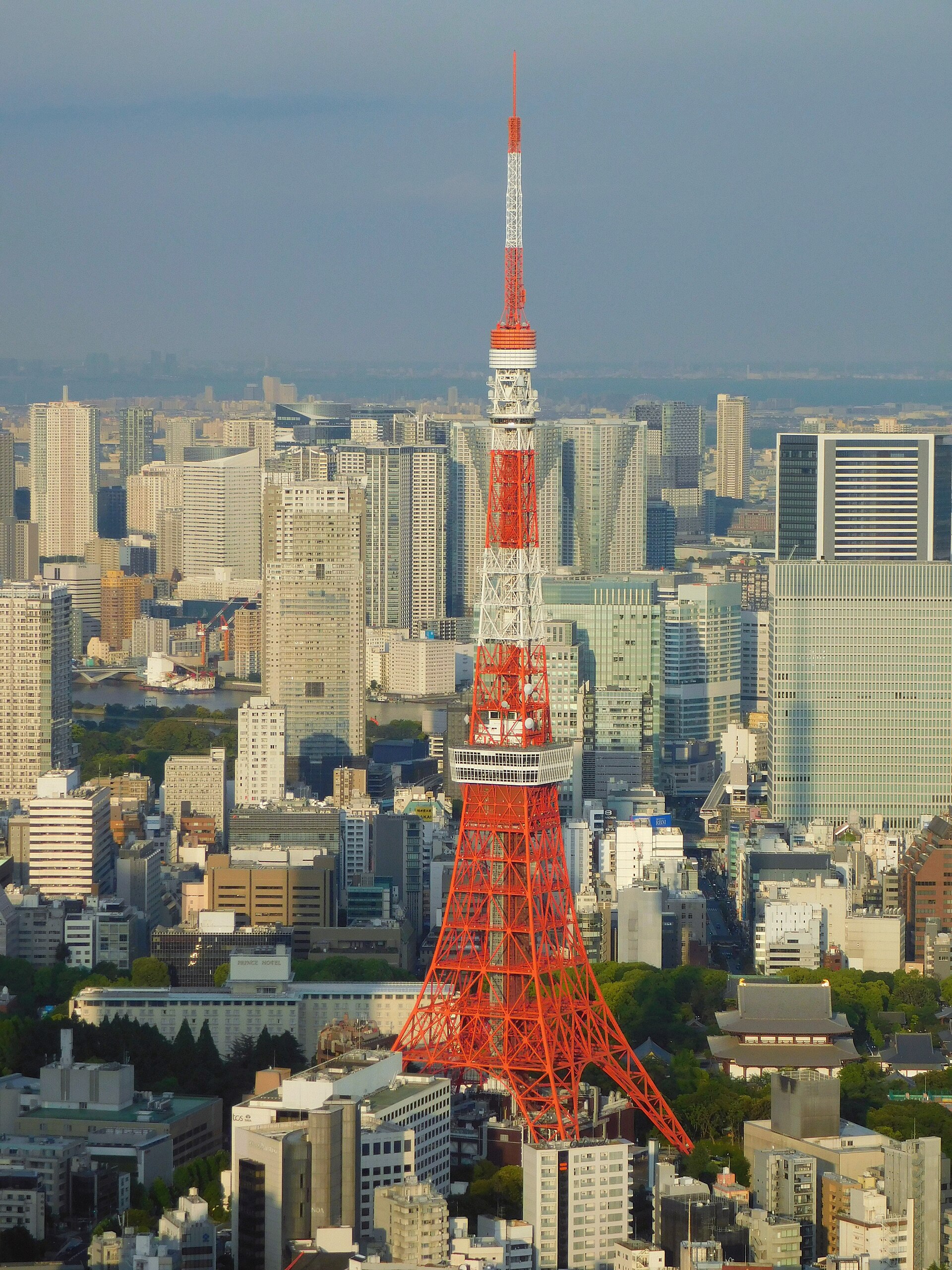
Seen from above, as in the photograph here, it reads almost like a drawing: four splayed legs planted in the trees of Shiba Park, a white observation deck cinched around its waist like a belt, and a needle climbing out of a second, smaller ring into the haze over the bay. The colours are not decoration. Aviation rules called for high visibility, and the tower answered with alternating bands of international orange and white that have defined it ever since.
The storyA beacon for a city rebuilding
Tokyo Tower was completed in 1958, thirteen years after the war had left much of the capital in ashes. Television was arriving in Japanese homes, broadcasters needed a single mast tall enough to reach the whole Kantō plain, and the city wanted a symbol of recovery it could see from anywhere. The structural engineer Tachū Naitō, already celebrated for buildings that had survived the 1923 earthquake, designed a free-standing steel lattice of 333 metres, a little taller than the Eiffel Tower that so obviously inspired it.
The comparison with Paris is unavoidable and slightly unfair. Gustave Eiffel's tower is wrought iron and curved like a sigh; Naitō's is steel, lighter, stiffer and engineered for typhoons and tremors. Part of that steel is often said to have come from scrapped tanks, a detail that has become a fixture of the tower's story. The look is pure late-1950s optimism: a little brash, wholly sincere, built to be seen.
For half a century it carried the city's television and radio signals. When the far taller Tokyo Skytree took over the main broadcasting role in the early 2010s, many expected the older tower to fade into nostalgia. Instead it became more beloved. Its scale is human enough to grasp; you can walk to it through a park, past a temple, and feel it grow above you.
Skytree is the record. Tokyo Tower is the one the city looks for out of a taxi window at night.— On Tokyo's two towers
The walkTemple, park and steel
The best approach is not from the nearest station exit but through the grounds of Zōjō-ji, the great Jōdo-shū temple that served as a family temple of the Tokugawa shoguns. You pass beneath the vermilion-lacquered Sangedatsumon, the old main gate, cross a wide gravel court and come to the main hall, whose heavy grey roofs appear at the lower right of the photograph. Turn around here and the tower rises directly behind the temple, a composition of four centuries of faith and twentieth-century engineering that no planner could have arranged on purpose.
Along one side of the temple grounds stand rows of small stone jizō statues dressed in knitted red caps and bibs, each with a plastic pinwheel that turns in the breeze. Parents place them in memory of children they have lost. It is a tender, quiet place, and the tower's legs are only a few minutes' walk beyond it through the trees of Shiba Park.
Up close the lattice is startlingly intricate, a thicket of riveted members painted by hand in a ritual repeated every few years. The Main Deck, at 150 metres, wraps the tower in a two-storey ring of glass; on a clear winter day Mount Fuji floats on the western horizon. Higher still, the Top Deck at 250 metres is a smaller, more theatrical space of mirrors and soft light, where the city below looks less like streets and more like circuitry. For anyone with sturdy legs, an outdoor staircase of roughly six hundred steps climbs to the Main Deck when it is open, and the wind through the girders is half the pleasure.
After darkThe tower lit
At night Tokyo Tower changes character entirely. The standard illumination, designed by the lighting artist Motoko Ishii, washes the structure from within in a warm amber glow that seems to come from the steel itself, cooler white in summer. On special occasions the tower wears other colours and patterns, and Tokyoites notice. It is a tower that is meant to be looked at as much as looked from.
Through the yearWhen to go
Spring
Cherry trees in Shiba Park and around Zōjō-ji frame the orange lattice in pale pink, one of the classic Tokyo compositions.
Summer
Humid haze softens the views from the decks, but long evenings and the summer lighting make the tower a fine night walk.
Autumn
The ginkgo trees around the temple turn butter yellow against the orange steel, and the air begins to clear.
Winter
The clearest skies of the year bring Mount Fuji into view from the Main Deck, especially on crisp mornings after a cold front.
Know before you goPractical notes
- Arrive through Zōjō-ji. The temple approach gives you the finest ground-level view of the tower and puts it in its historical setting.
- Check the weather, not just the forecast. Visibility makes or breaks the decks; look out of your hotel window before committing.
- Consider the stairs. When the outdoor staircase is open, climbing to the Main Deck is a memorable way to feel the structure around you.
- See it from elsewhere, too. Some of the best views of the tower are from other heights in Roppongi and Minato, where it fills the frame as in our photograph.
- Stay for dusk. Watching the lights come on transforms the tower from a daytime sight into the warmest thing on the skyline.