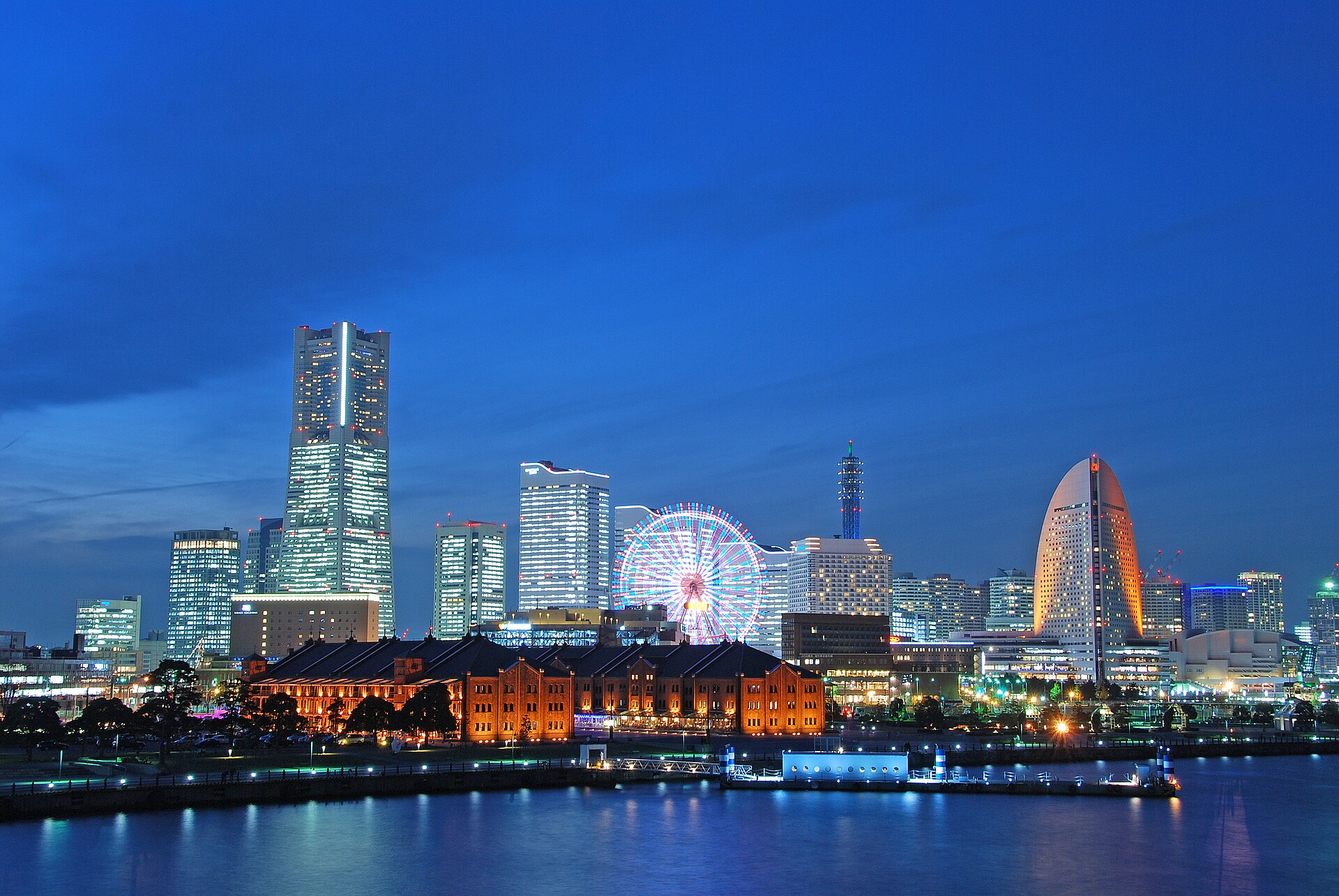

A short train ride south of Tokyo, the land simply runs out and turns into harbour. Here Yokohama has built its showpiece, a waterfront district of towers and promenades called Minato Mirai, "harbour of the future." Come in the afternoon and it looks like a tidy business quarter with good sea air. Stay until the sky deepens to ink and the whole shoreline switches on, and you understand why the city chose to put its best face toward the water.
The scale is generous in a way central Tokyo rarely allows. Streets are wide, pavements wider, and almost every walk ends at a railing with gulls, moored boats and the low hum of the port. It is a place built for strolling, which is exactly how it should be seen.
The storyA port that reinvented itself
Yokohama was a fishing village when it was opened to foreign trade in 1859, and within a few decades it had become Japan's great gateway to the world: silk went out, steamships, gas lamps and Western ideas came in. The shoreline that is now Minato Mirai was once docks, rail sidings and shipyards, the working machinery of that trade.
When heavy industry moved on, the city made a bold decision. Rather than let the old yards decay, it reclaimed and replanned the waterfront from the 1980s onward as a new urban centre, linking the historic Kannai district with the area around Yokohama Station. The "21" in the name signals the ambition: a district designed for the twenty-first century.
Its first great landmark was the Yokohama Landmark Tower, completed in 1993, which held the title of Japan's tallest building for two decades. Yet the district's charm lies as much in what it kept. A stone dry dock from the shipbuilding era was preserved as a sunken plaza, the old freight rail line became a waterside promenade, and two red-brick customs warehouses from the early 1900s were restored and given a second life.
Stay until the sky deepens to ink and the whole shoreline switches on.— On the harbour wall
The walkFrom brick to glass
Start at Sakuragichō Station and walk toward the water. The Landmark Tower rises directly ahead, and at its foot the old dry dock sits below street level, its stepped stone walls now an amphitheatre for buskers and lunchtime crowds. Nearby, the tall ship Nippon Maru, a former training vessel for merchant cadets, rests in its own preserved dock with its masts against the towers.
Follow the Kishamichi promenade, the former rail line, as it hops across the water on old iron bridges toward the amusement park at Cosmo World, where the Cosmo Clock 21 Ferris wheel doubles as a giant clock face. Beyond it lie the Red Brick Warehouses, Aka-renga Sōko, now filled with shops and cafés, their cobbled forecourt hosting seasonal markets. A short walk farther brings you to the Ōsanbashi pier, whose undulating timber deck rolls out into the bay like the back of a whale and makes a superb open-air viewing platform.
Look back from Ōsanbashi and you have a view much like the one in our photograph: the tower, the wheel, the sail-shaped InterContinental hotel at Pacifico Yokohama, and the warehouses glowing at the waterline. For a higher perspective, the Sky Garden near the top of the Landmark Tower looks out over the bay and, on clear winter days, toward Mount Fuji.
Beyond the skylineNoodles, gardens and a short walk to Chinatown
The district rewards curiosity. The Cup Noodles Museum celebrates the instant noodle, invented by Momofuku Andō, with a cheerful workshop where you can design your own cup. Rinkō Park offers a broad lawn running down to the sea, a favourite for picnics and for watching the bay. From the warehouses, a waterside path leads on to Yamashita Park and the old liner Hikawa Maru, and from there it is a few streets to Yokohama Chinatown, the largest in Japan, for dinner.
Through the yearWhen to go
Spring
Cherry trees bloom along the Ōoka River by Sakuragichō and down the district's own Sakura-dōri, softening the steel with pink.
Summer
Warm, humid evenings bring sea breezes and fireworks over the harbour; arrive early for a spot on the waterfront.
Autumn
Clear air and mild days make this the best season for long walks between the piers.
Winter
Illuminations and a Christmas market at the Red Brick Warehouses; crisp days sometimes reveal Fuji from the heights.
Know before you goPractical notes
- Choose your station. JR Sakuragichō puts you at the foot of the Landmark Tower; the Minatomirai Line runs through the heart of the district toward Motomachi-Chūkagai.
- Walk it one way. Start at Sakuragichō and end in Chinatown or Yamashita Park, so you never retrace your steps.
- Time it for dusk. Arrive in late afternoon and let the light change around you; the skyline is at its best in the half hour after sunset.
- Mind the wind. The open piers can be breezy even on mild days; bring a layer for the evening.
- Pair it with Tokyo. Yokohama is an easy half-day or evening trip from the capital, and combines well with Kamakura to the south.