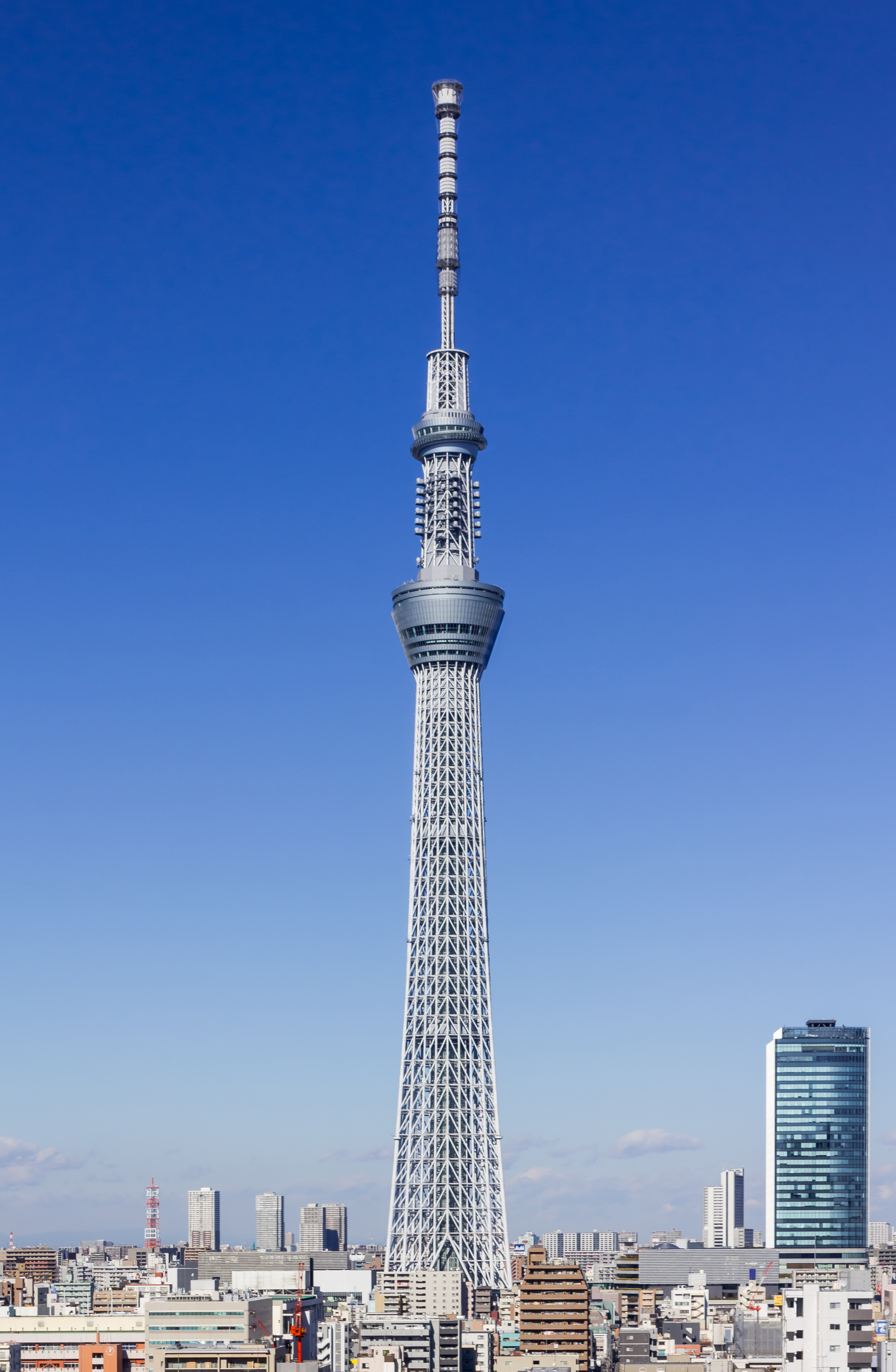

Most great towers announce themselves from a plaza. Tokyo Skytree simply appears, sliding into view at the end of a shopping street, over a canal, above a laundry line in Oshiage. At 634 metres it is the tallest structure in Japan, yet it rises from one of the city's lowest, most lived-in neighbourhoods, a district of small workshops, narrow lanes and family-run sentō on the east bank of the Sumida River.
That contrast is the point. Seen from the shitamachi streets around its base, the tower reads less as a monument than as a fixed star, something the neighbourhood steers by. Climb it, and the relationship flips: the city that loomed around you becomes a grey and silver tide running to the mountains, and you finally understand how much of Tokyo there is.
The storyA tower drawn from old lines
Skytree opened in 2012 as a broadcasting tower, built to carry digital television signals over a capital whose skyscrapers had outgrown the reach of Tokyo Tower. The height was chosen with a wink. Read in Japanese syllables, six, three and four become mu-sa-shi, the name of the old province that once covered Tokyo and much of the surrounding plain.
The shape is subtler than it looks in photographs. At ground level the footprint is a triangle, a stable stance for a tall structure on a cramped site. As the tower climbs, that triangle softens and resolves into a circle, so the silhouette changes as you walk around it: from one angle the profile bows gently inward, from another it swells, echoing the concave sori and convex mukuri curves of temple roofs and Japanese swords. The steel is painted a white with a whisper of blue, drawn from aijiro, the palest shade of traditional indigo dye.
Inside, a reinforced-concrete column runs up the centre, structurally separate from the steel frame around it. Its designers took the idea from the shinbashira, the central pillar of a five-storey pagoda, a device that has helped wooden towers in this earthquake country ride out tremors for centuries. It is a good thing to know when the lift doors open several hundred metres up and the floor feels very far from the ground.
Climb it, and the city that loomed around you becomes a grey and silver tide running to the mountains.— On the way up
The climbTwo decks, two moods
The ascent happens in two stages. Fast lifts carry you to the Tembo Deck at 350 metres, a wide, three-level ring of floor-to-ceiling glass where most people linger. Here the scale arrives all at once. The Sumida River coils past Asakusa, where the roofline of Sensō-ji is a small dark shape among the blocks; the expressways braid themselves around Ryōgoku; the towers of Shinjuku stand clustered on the western horizon like a separate city. Look straight down through the glass floor panels if your stomach allows.
A second lift continues to the Tembo Galleria at 450 metres, where a sloping glass corridor spirals gently upward around the tower's outer edge. It is quieter and narrower than the deck below, and the effect is closer to walking along a cliff path than standing at a window. The light changes as you circle: harsh and silvery to the south over the bay, softer to the west, where on clear mornings the cone of Fuji sits pale and unexpected above the haze.
Back on the ground, Tokyo Solamachi, the complex wrapped around the tower's base, holds an aquarium, a planetarium and several floors of shops and food. It is worth an hour, but the better reward is outside: walk ten minutes in any direction and the tower reappears in fragments, framed by a shrine gate, reflected in the narrow Kitajukken River, glimpsed between the eaves of wooden houses.
Through the yearWhen to go
Spring
Cherry trees in Sumida Park, strung along the river, frame the tower in pink; the views upstairs soften in the season's haze.
Summer
Humidity veils the distance, but the Sumida River fireworks in late July pack the riverbanks, the tower glowing above the bursts.
Autumn
The air begins to clear. Sunsets grow long and amber, and the first days with Fuji on the horizon return.
Winter
The best season for the view. Dry, cold air sharpens every edge, and the mountains ringing the Kantō plain stand out crisp and blue.
Know before you goPractical notes
- Watch the sky, not the clock. A clear day matters more than any hour. If the top of the tower is in cloud, save the climb for another day and walk the neighbourhood instead.
- Book ahead in busy seasons. Timed tickets sold in advance spare you the longest queues on weekends and holidays.
- Go up before sunset. Arrive in late afternoon to see the city by day, watch it turn gold, then stay as the lights come on below.
- Combine it with Asakusa. Sensō-ji is a pleasant walk across the Sumida, and the bridges between the two give some of the best low-angle views of the tower.
- Mind the glass. Dark clothing reduces reflections if you want clean photographs through the windows after dark.