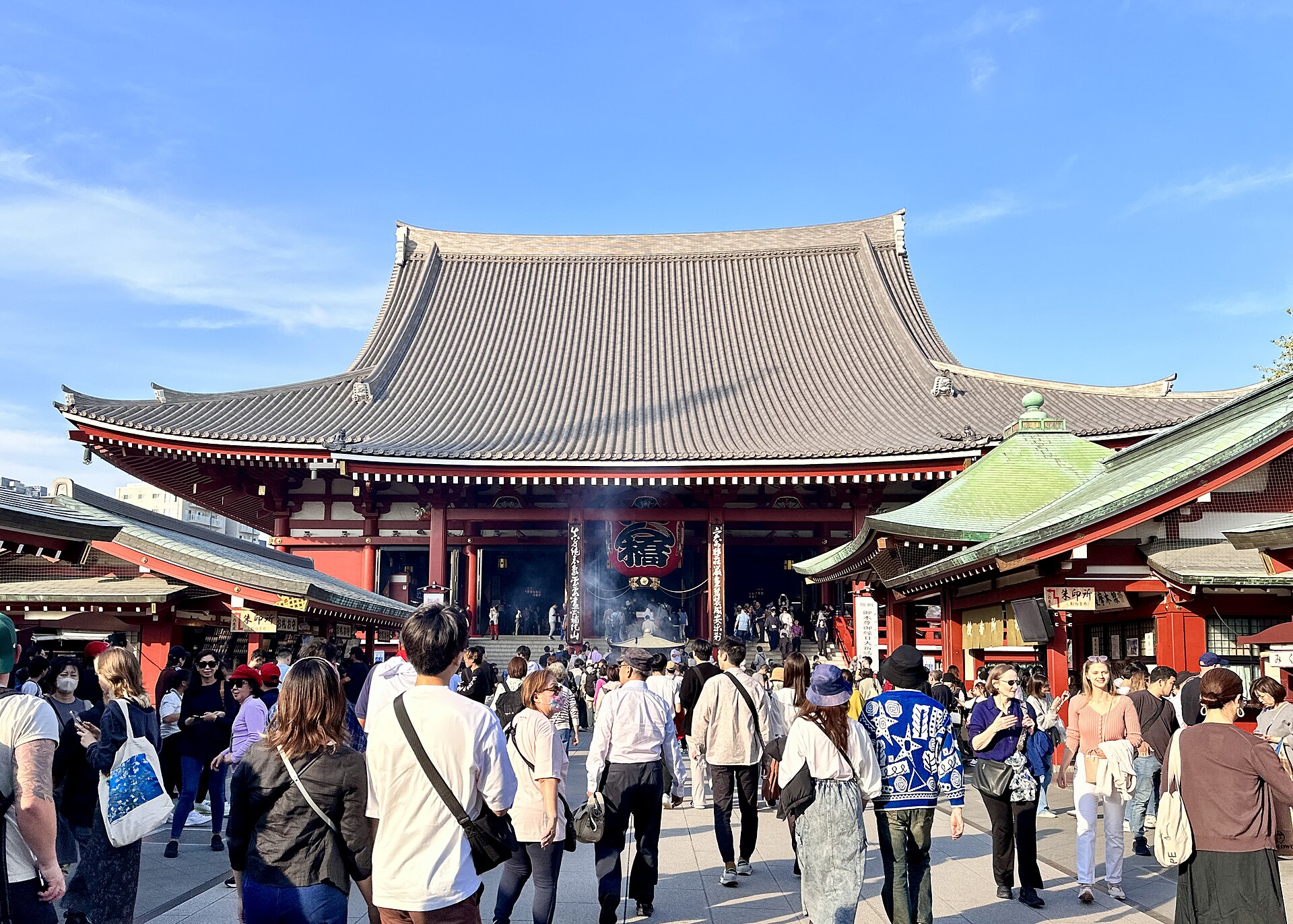

Smell it before you see it. Somewhere past the souvenir stalls, a thread of sandalwood finds its way through the fried-dough sweetness of Nakamise, and then the forecourt opens and there it is: a vermilion hall beneath a roof so steep and heavy it seems to lean on the sky. Sensō-ji is Tokyo's oldest temple, and also its busiest. Both facts are true at once, and that is the point.
Most of Tokyo's great sights ask you to look. Sensō-ji asks you to join in. The grandmother wafting smoke over her knees, the schoolboy shaking a fortune stick from a steel canister, the salaryman pausing for a two-second bow on his way to the train: this is a working temple in the middle of a working neighbourhood, and it has been one for longer than the city has had its name.
The storyA goddess in a fishing net
The founding legend is plain and lovely. In the year 628, two fisherman brothers, Hinokuma Hamanari and Hinokuma Takenari, were working the Sumida River when their net came up holding a small golden statue of Kannon, the bodhisattva of compassion. They threw it back. It returned to the net. The village headman, recognising what they had found, turned his own house into a place of worship, and a temple grew around the image.
That statue has never been put on public view. It is a hibutsu, a hidden Buddha, kept out of sight in the inner sanctuary, and the whole vast apparatus of gates, halls and incense exists for something no visitor will see. Locals still call the temple simply Asakusa Kannon. Its formal mountain name, Kinryū-zan, the Golden Dragon Mountain, recalls a dragon said to have descended from the sky when the temple was founded.
Through the Edo period Asakusa became the city's great pleasure quarter, all theatres, archery stalls and teahouses crowding the temple's skirts. Much of the precinct was destroyed in the air raids of 1945. The Main Hall you see today was rebuilt after the war, in reinforced concrete beneath its traditional profile, and the Hōzōmon and five-storey pagoda followed. If the materials are modern, the devotion is not; the smoke, the coins and the bowed heads never stopped.
The whole vast apparatus of gates, halls and incense exists for something no visitor will see.— On the hidden Kannon
The walkGate, street, gate, hall
Arrive by Kaminarimon, the Thunder Gate, with its enormous red paper lantern and the gods of wind and thunder glaring from behind their grilles on either side. Beyond it runs Nakamise-dōri, a long double row of shops selling paper fans, boxwood combs, rice crackers brushed with soy and ningyō-yaki, little sponge cakes baked in moulds and often filled with sweet bean paste. It is a street that has fed pilgrims for centuries, and it still does the job cheerfully.
The second gate, Hōzōmon, is the grander of the two, its rear wall hung with a pair of colossal straw sandals woven in Yamagata Prefecture and offered as a charm against evil. Pass through and the forecourt widens. To the left rises the five-storey pagoda; ahead, the great bronze incense burner, the jōkōro, sends up its constant grey plume. Do as everyone does: light a bundle of sticks, drop it in, and draw the smoke over whatever part of you needs mending. Head, for exams. Shoulders, for a stiff week.
Climb the steps of the Main Hall, toss a coin, bow, and stand a moment in the dim, gilded interior. On either side of the forecourt, low copper-roofed pavilions house the stalls where you can have a goshuin, the brushed-ink temple seal, written into a stitched book. Then wander to the right of the hall, to Asakusa Shrine, the Shinto shrine to the brothers and the headman, which survived the war and wears its age with a darker, quieter grace.
The fortune papers, omikuji, are drawn by shaking a numbered stick from a canister and fetching the matching slip from a wall of little drawers. Sensō-ji is known for handing out an unusually honest share of bad luck. If yours is grim, tie it to the rack provided and leave it behind.
Through the yearWhen to go
Spring
Cherry blossom along the nearby Sumida River, and in May the Sanja Matsuri, when portable shrines are carried through Asakusa's streets in one of Tokyo's loudest, happiest festivals.
Summer
In July the Hōzuki-ichi fills the precinct with stalls of orange-lanterned ground cherries in pots; a visit on its main day is said to earn the merit of tens of thousands of days.
Autumn
Clear skies and long, low light that sets the vermilion glowing against a hard blue sky. The crowds ease a little between holidays.
Winter
December brings the Hagoita-ichi, a fair of ornate battledores, and the New Year draws the largest crowds of all for the first prayer of the year.
Know before you goPractical notes
- Go early or go late. The precinct is open grounds, and at dawn or after dark it belongs to joggers, dog-walkers and a handful of worshippers.
- Walk, then eat. Eating while walking along Nakamise is discouraged; stand by the stall where you bought your snack and finish it there.
- Mind the smoke. The incense burner is hot and busy. Waft gently, keep sleeves and hair clear, and step aside once you are done.
- Photograph with care. Avoid photographing inside the Main Hall during worship, and give people at prayer their space.
- Explore the edges. The lanes west of the temple hold old craft shops, tempura counters and the Hoppy-dōri drinking stalls, a better lunch than anything on the main approach.