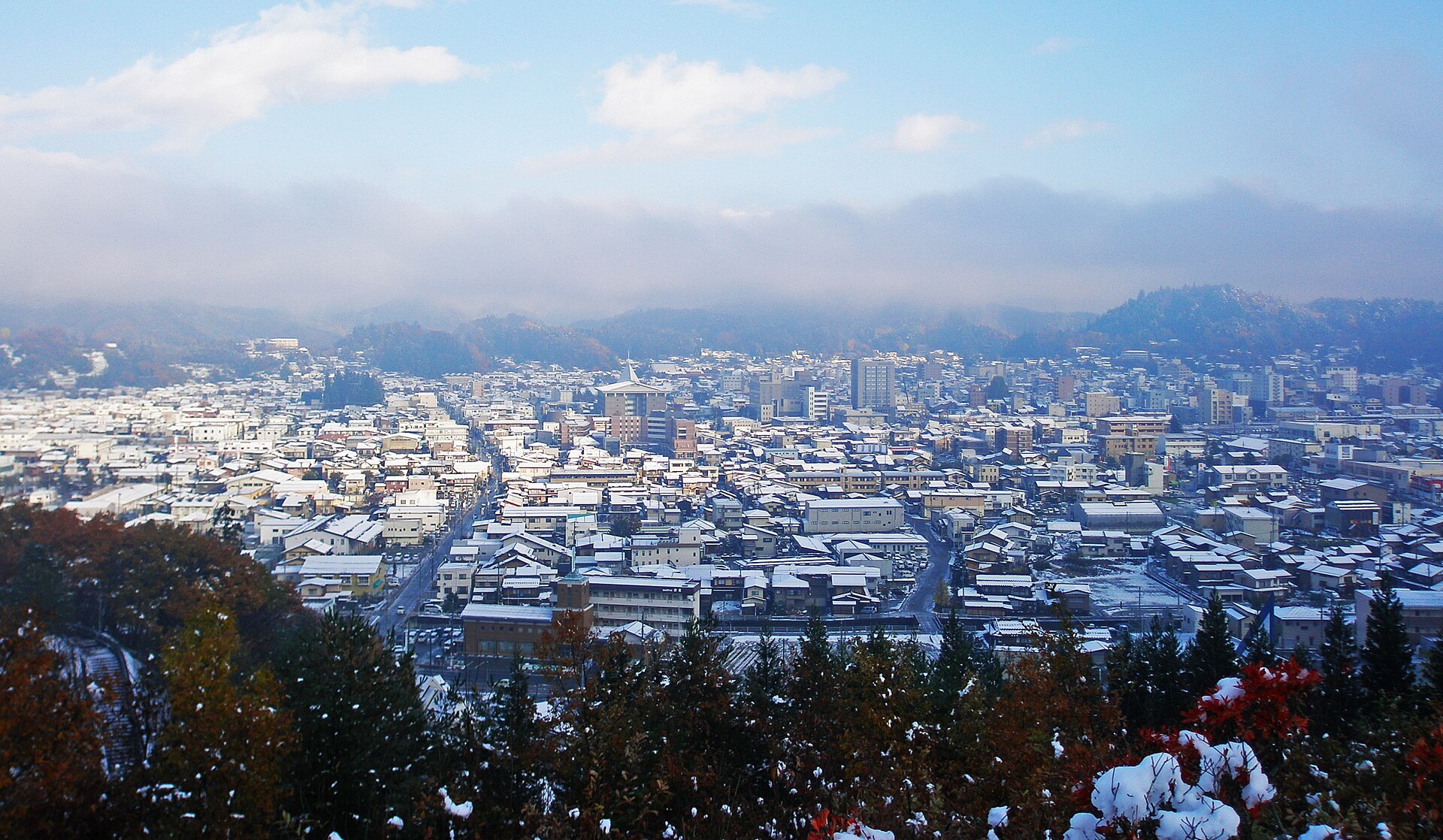

Takayama sits in a high basin in the Hida mountains of northern Gifu, ringed by ridges that hold the cloud like a lid on a pot. For centuries the valley was hard to reach and slow to change, and it shows. The old quarter is a grid of low, dark-timbered merchant houses with latticed fronts, and on a cold morning the smell of steamed rice drifts out of the breweries before the shops have even raised their shutters.
From the hills on the town's edge, as in the photograph above, Takayama looks like any modern regional city: apartment blocks, a railway line, roofs running to the foot of the mountains. The trick is to come down into it. The historic centre is compact, walkable in an afternoon, and rewards the traveller who stays the night and wakes early enough to see it before the day-trippers arrive.
The storyA town built by carpenters
Hida was a poor province for rice but rich in timber, and under the imperial law codes of the eighth century it was allowed to pay its dues to the court in labour rather than in goods. Its woodworkers, the Hida no takumi, were sent to help raise the great temples and palaces of Nara and Kyoto, and the reputation stuck. You can see that inheritance everywhere in Takayama: in the precise joinery of the townhouse façades, in the carved and lacquered festival floats, in the workshops still turning out furniture of pale, bent wood.
The town took its present shape as a castle town under the Kanamori clan in the late sixteenth century. At the end of the seventeenth century the shogunate took Hida under its direct control, prizing its forests and mines, and governed it from a compound in the centre of town. That building, Takayama Jinya, is the only shogunal government office of the Edo period whose main buildings still stand, with its tatami offices, rice storehouses and a stark white-gravel courtyard where cases were once heard.
The castle itself is long gone; its hill is now Shiroyama Park, a wooded rise of paths and stone walls on the east side of town. What remains is the merchant city that grew up below it, prosperous on timber, sake and trade, and conservative enough to keep its old houses standing.
On a cold morning the smell of steamed rice drifts out of the breweries before the shops have raised their shutters.— In the old quarter
The walkLattices, markets and cedar balls
Start at the Miyagawa morning market, strung along the east bank of the river that cuts through town. Growers sell pickles, mountain vegetables, miso and apples from folding tables; there are wood carvers and stalls of sarubobo, the faceless red cloth dolls that Hida grandmothers once made for children as charms. Across town, a smaller market sets up in front of the Jinya gates.
A short walk east brings you to Sanmachi, the preserved merchant district, where three narrow streets run parallel between rows of two-storey wooden houses. The timber has weathered almost black, gutters of clear water run along the edges, and the eaves are low enough that you instinctively slow down. Look up for sugidama, the balls of bound cedar sprigs hung above brewery doors. Hung green when the new sake is pressed, they slowly fade to brown as it matures, a calendar you can read from the street. Several breweries open their doors for tastings.
For food, the local signatures are Hida beef, richly marbled and often served grilled on a magnolia leaf with miso, and mitarashi dango glazed with soy sauce rather than the sweet syrup found elsewhere. Thin, soy-based Takayama ramen is the town's working lunch.
Two places deserve time beyond the old streets. The Yatai Kaikan, beside Sakurayama Hachiman-gū, displays a rotating selection of the festival floats so you can see their carving and metalwork up close. On a hillside west of the station, Hida no Sato is an open-air museum of thatched farmhouses moved from across the region, gathered around a pond: a quiet preface, if you are heading on to Shirakawa-gō.
Through the yearWhen to go
Spring
The Sannō festival in mid-April rolls the gilded floats out, often beneath late cherry blossom, with mechanical puppets performing on top. Book rooms well ahead.
Summer
The basin is cooler than the lowland cities, and long evenings suit slow walks along the river and the temple path in the Higashiyama hills.
Autumn
The Hachiman festival returns the floats in early October, lit by lanterns after dark, and the surrounding hills turn copper and red.
Winter
Snow settles on the dark roofs, new sake is pressed and the cedar balls go up green. Quieter, colder and deeply atmospheric.
Know before you goPractical notes
- Stay the night. Day groups thin out by late afternoon. A ryokan or minshuku lets you walk Sanmachi at dusk and reach the morning market early.
- Sip with intent. Brewery tastings are generous and the sake is strong. Pace yourself, eat something first, and leave room for a bottle to carry home.
- Use Takayama as a base. Shirakawa-gō and the Okuhida hot-spring villages are both reachable by bus, making the town a natural hub for the northern Alps.
- Dress for the altitude. Winters are properly cold and snowy; bring grippy shoes for icy lanes from December onwards.
- Mind the houses. Many Sanmachi buildings are private homes and working businesses. Keep doorways clear and ask before photographing people.