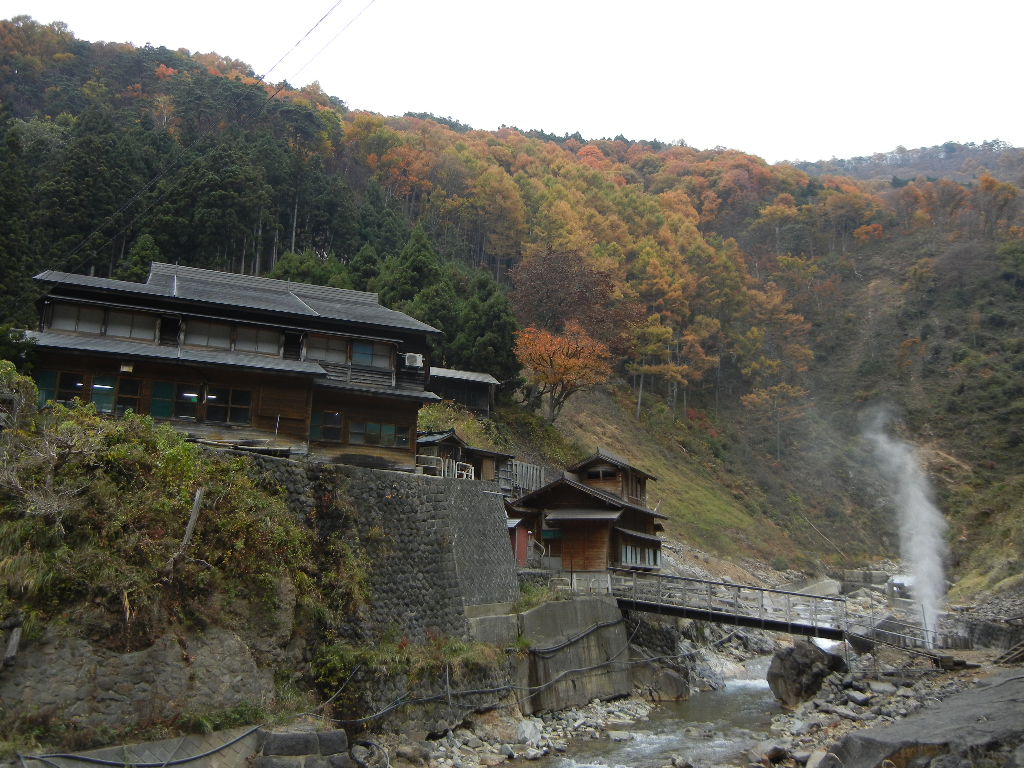

You hear the valley before you see it. The forest path from Kanbayashi Onsen runs level through cedar and larch, and then the slope falls away into a gorge that hisses. Steam drifts off the rocks of the Yokoyu River, a spring spits a white column into the air, and on the far bank a troop of Japanese macaques goes about its morning, grooming, squabbling and, if the air is cold enough, lowering itself into hot water up to the chin.
Jigokudani means "Hell's Valley", a name earned by the vents and boiling springs that scar its steep sides and by winters that bury it in deep snow. It sits in the upper reaches of Yamanouchi, inside Jōshin'etsu Kōgen National Park, at the foot of the Shiga Kōgen highlands. Nothing here was built to impress. A handful of wooden buildings, a river, a pool, and a population of wild animals who tolerate you because they have long since decided you are not worth worrying about.
The storyHow the monkeys found the bath
Japanese macaques, Macaca fuscata, live farther north than any other non-human primate, and the troops of the Nagano mountains are built for it: thick grey-brown coats, red faces, short tails, a habit of huddling in tight knots when the wind turns. They have ranged across these slopes for as long as anyone has recorded, raiding orchards in the valleys below when the forest ran thin.
The park was established in 1964 to give the local troop a protected home and to draw it away from the farms. Keepers began offering food in the valley, the monkeys began spending their days near the river, and before long a few of them were climbing into the hot spring water, a habit that spread through the troop as others copied the first bathers. A dedicated pool now serves them, separate from the baths of the old inn nearby. Photographs of steaming, frost-tipped faces travelled the world, and the Nagano Winter Olympics of 1998 sealed the valley's reputation as the place where the snow monkeys bathe.
What surprises most visitors is how ordinary it all feels to the animals. This is not an enclosure. The monkeys come down from the forest each day of their own accord and climb back up when they please. You are a guest in their routine, and the routine does not change for you.
You are a guest in their routine, and the routine does not change for you.— On the riverbank
The walkThrough the forest, into the steam
The approach is part of the pleasure. From the trailhead the path runs for a little under two kilometres along the hillside, wide and gentle, through tall conifers that hush the sound of the road. In deep winter it is packed snow and ice; the cold sharpens everything, and the smell of woodsmoke and sulphur reaches you before the river does. Where the path drops into the gorge you pass old wooden inn buildings perched above the water, a footbridge, and the spouting spring that throws its steam high against the hillside.
Beyond lies the monkeys' pool, a plain stone-edged basin above the river. Around it the troop arranges itself by rank and temperament. Mothers clutch infants to their chests. Juveniles wrestle on the rocks and dare one another toward the edge. Older animals sit in the water with their eyes half closed, hands folded, faces glazed with steam, looking for all the world like retired bathers at a provincial onsen. Not every monkey bathes; many prefer to forage, groom or doze on the warm stones nearby, and the mix is what makes the scene feel alive rather than staged.
Stay long enough and the small dramas come into focus: a dominant male clearing the warmest corner, a youngster dunking itself and emerging in a spiky, indignant halo of wet fur, a grooming chain passing slowly along the bank. An hour passes quickly. Two is not too many.
Through the yearWhen to go
Spring
Snow lingers on the path into spring, then the valley greens. Infants arrive in late spring and early summer, and soon ride on their mothers' backs.
Summer
Lush and quiet, with the monkeys rarely bothering with the bath. Come for the young ones at play and the cool of the forest.
Autumn
The slopes turn amber and rust, as in our photograph, and the first cold mornings coax the bolder monkeys back toward the water.
Winter
The classic season. Snow on the rocks, steam on the pool, and the most monkeys in the water. Bring traction for icy paths.
Know before you goPractical notes
- Keep your distance. These are wild animals. Do not touch them, stare into their eyes, or walk between a mother and her young.
- Never feed them. Food of any kind, including snacks in an open bag, invites trouble. Keep it packed away out of sight.
- Dress for the trail. The forest walk takes around half an hour each way. In winter, waterproof boots and slip-on crampons make the difference.
- Mind the camera. Shoot from the path and rocks rather than leaning over the pool, and leave selfie sticks and tripods folded in crowds.
- Check conditions. Heavy snow or storms can close the trail, and the monkeys keep their own schedule. Confirm before you set out.