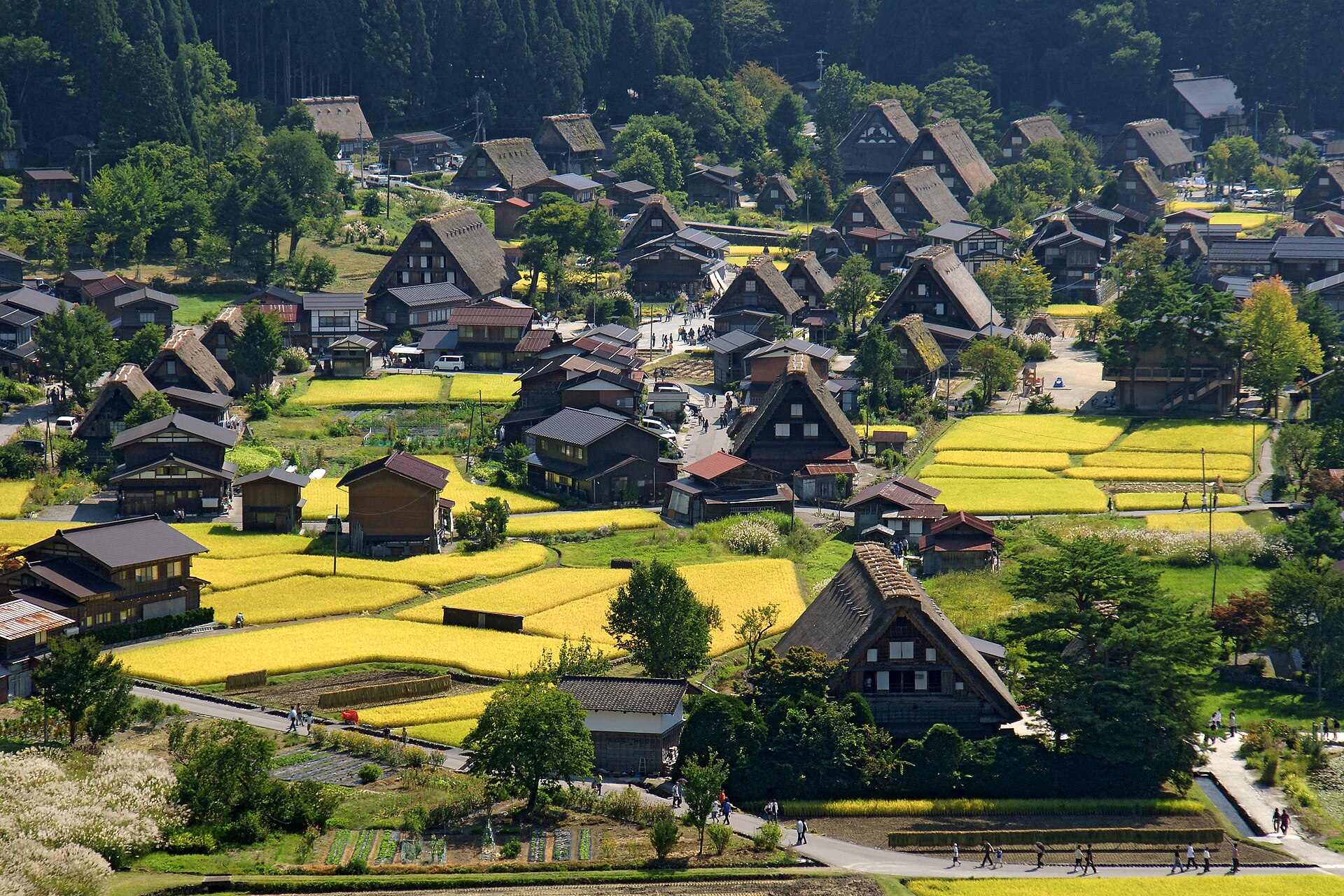

From the hillside above Ogimachi, the village looks less built than grown. Dark timber farmhouses rise out of the paddies under roofs of thatch so steep they seem to lean into one another, and the whole valley floor is quilted in green, then gold, then white. The Shō River runs along one side, cedar forest climbs the other, and for a few minutes you can believe the road out never existed.
Shirakawa-gō sits in the far north of Gifu Prefecture, in a fold of mountains that for centuries kept it apart from the rest of Japan. Heavy snow closed the passes each winter, and the people who lived here learned to build for it. What they built is the reason you come: the gasshō-zukuri farmhouse, one of the most distinctive pieces of vernacular architecture anywhere in the country.
The storyRoofs shaped like prayer
Gasshō means hands joined in prayer, and the name describes the roof exactly: two great planes of thatch meeting at a sharp ridge, steep enough to shed the weight of a mountain winter. The great rafters are lashed together with straw rope and pliant branches rather than nailed, which lets the structure flex under snow and wind. Under the eaves, the tall attic was not wasted space. Families raised silkworms on its slatted upper floors, warmed by the smoke and heat rising from the open hearth below, and that same smoke helped preserve the timber and thatch.
A roof like this cannot be maintained by one household. Rethatching a single house takes a great deal of grass and a great many hands, and so the village developed yui, a custom of mutual labour in which neighbours turn out to strip and relay a roof in a matter of days, then wait for the favour to be returned. The practice survives, and it is the quiet engine behind everything you see.
In 1995, Shirakawa-gō and the neighbouring Gokayama villages in Toyama Prefecture were inscribed together on the UNESCO World Heritage List. Ogimachi is the largest of the protected settlements and the one most visitors mean when they say Shirakawa-gō. People still live, farm and run guesthouses inside these houses, which is the difference between a village and a museum.
A roof like this cannot be kept by one household. It is kept by a village.— On the hillside above Ogimachi
The walkAcross the river and up the hill
Most arrivals begin on the far bank of the Shō and cross into the village on a long footbridge that sways slightly underfoot, the water running jade-green and fast below. From there the lanes spread out loosely between the houses, past irrigation channels where carp drift and vegetable plots edged with cosmos and silver grass. There is no grand avenue. The pleasure is in the wandering, in coming around a storehouse and finding a roof suddenly towering over you, its thatch furred with moss on the shaded side.
A few of the largest farmhouses are open to visitors, and it is worth going inside at least one. The Wada House, among the biggest in the village, lets you climb the steep wooden stairs into the attic floors, where the roof frame becomes a vast tent of timber and rope and the light falls in slats through the gable windows. Downstairs, the hearth room smells faintly of smoke and old wood. Myōzen-ji, the village temple, keeps a thatched bell tower and a thatched main hall, an unusual sight that underlines how completely this one way of building took hold here.
Then climb, or ride the shuttle, to the Shiroyama viewpoint on the ridge above the village. This is the view on the postcards and on this page: the roofs all turned the same way along the valley, aligned to the wind and to catch the sun on their broad faces. Give it time. Watch the light move across the fields, the small figures on the paths, a thread of hearth smoke seeping through the thatch. It is the clearest way to understand Shirakawa-gō as a single organism rather than a collection of houses.
Through the yearWhen to go
Spring
Snow lingers on the surrounding peaks as the paddies are flooded, turning the valley floor into a patchwork of mirrors.
Summer
Deep green rice, cicadas in the cedars and cool air off the river; the village at its most lived-in and often at its quietest.
Autumn
The rice ripens to gold, silver grass plumes along the field edges and the forest turns to rust and amber. Our favourite season, and the one in the photograph.
Winter
Snow piles high on the thatch and the village becomes the scene everyone has seen on posters. Beautiful, popular and cold; for the special evening illuminations, access is tightly controlled, so plan well ahead.
Know before you goPractical notes
- Stay the night. Day-trippers leave in the late afternoon. A night in a farmhouse inn, with dinner around the hearth, gives you the empty lanes of evening and early morning.
- Pair it with a neighbour. Shirakawa-gō sits between Takayama and Kanazawa and fits naturally into a journey from one to the other.
- Remember people live here. Many houses are private homes. Keep to the lanes, do not step into gardens or paddies, and ask before photographing residents.
- No drones, no smoking in the lanes. Thatch is extraordinarily flammable, and fire is the village's oldest fear.
- Dress for the mountains. Even in summer the valley can be cool and wet; in winter the paths are packed snow and ice, so bring proper boots.