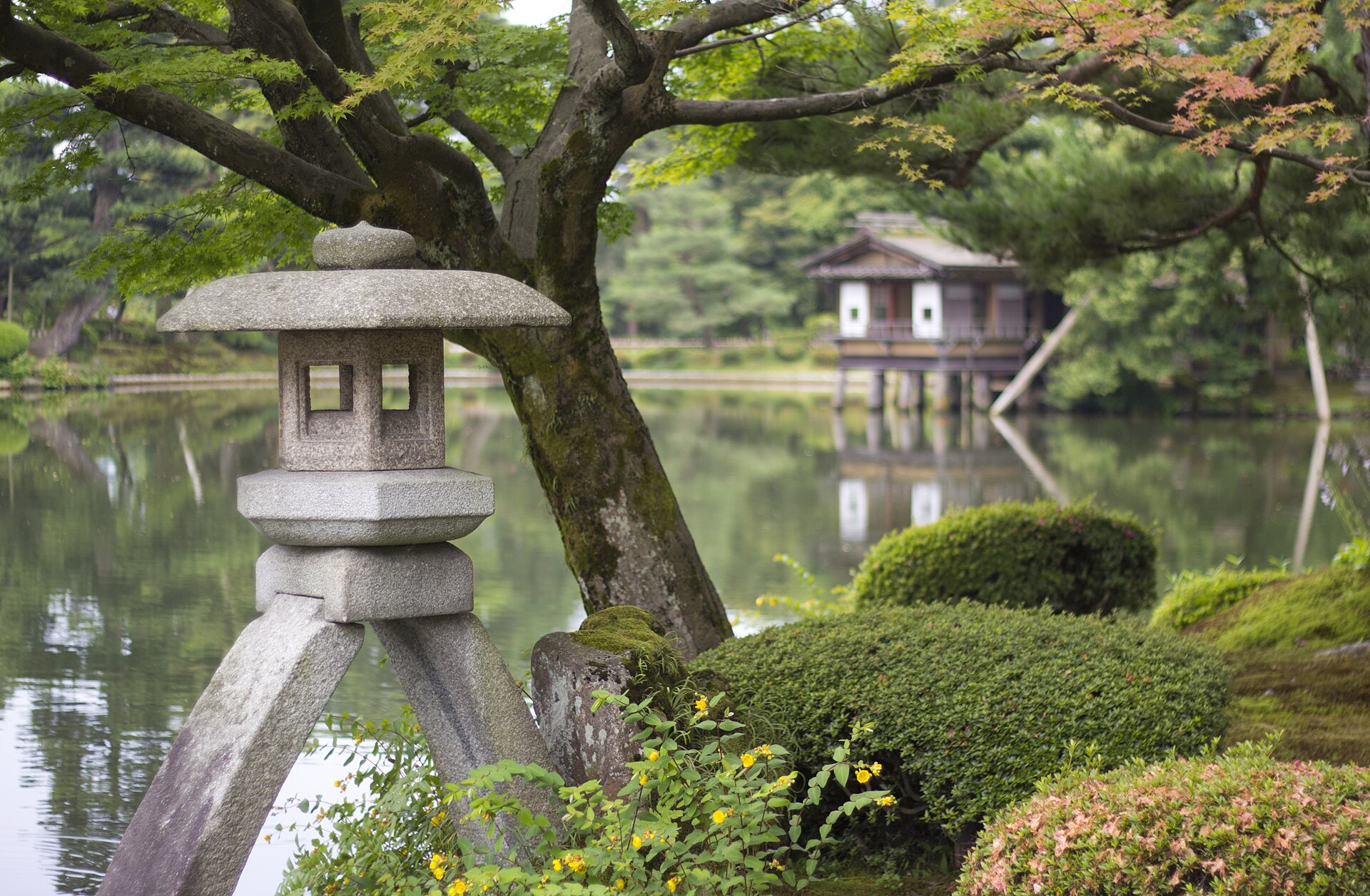

The lantern is the first thing everyone photographs, and for good reason. Two granite legs of unequal length plant it at the edge of the water, one on the bank and one on a stone in the pond, so that it seems caught mid-stride. A maple leans over it. Behind, across a sheet of green-grey pond, a small teahouse stands on wooden piles and doubles itself in the reflection. It is a composed picture, and it was meant to be.
Kenroku-en, in the castle town of Kanazawa on the Sea of Japan coast, is counted among the three great gardens of Japan, alongside Kairaku-en in Mito and Kōraku-en in Okayama. For many visitors it is the finest of the three, and it is certainly the one that most rewards slowness. It is not a single view but a sequence of them, unfolding across hills, ponds, streams and groves as you walk.
The storyA garden of six virtues
The garden began as the outer grounds of Kanazawa Castle, home of the Maeda, one of the wealthiest domain lords of the Edo period. Successive generations of the family shaped and reshaped it from the late seventeenth century onward, adding ponds, teahouses and streams, so that what you walk through today is less a design than an accumulation: the taste of many lords, layered and refined.
Its name was bestowed in the early nineteenth century and borrows from a Chinese Song-dynasty text on gardens, which held that no garden could combine all six qualities of a perfect landscape. Those six are spaciousness and seclusion, artifice and antiquity, flowing water and broad views. Each pair seems to cancel itself out. A garden that feels vast cannot feel secluded; one that is plainly made by hand cannot feel old. Kenroku-en, literally "the garden combining six," was named for having done it anyway.
The water is the garden's quiet feat of engineering. It arrives by the Tatsumi canal, dug in the seventeenth century to carry water from the Sai River into the castle grounds, and it runs through the garden by gravity alone. Beside Hisago-ike, a smaller pond in the lower garden, the difference in height drives a small fountain held to be the oldest of its kind in Japan, throwing a plain jet of water upward with no pump at all. The garden opened to the public in the 1870s, after the end of the feudal era, and has since been designated a Special Place of Scenic Beauty.
Each pair of virtues seems to cancel itself out. The garden was named for reconciling them anyway.— On the name
The walkWhat you will see
Kasumiga-ike, the "misty pond," is the heart of the place. It holds a small turtle-shaped island, and around its rim stand the garden's best-known features: the Kotoji-tōrō lantern, whose legs are said to recall the bridges that hold up the strings of a koto, and the Uchihashi-tei teahouse, perched half over the water. Nearby the Karasaki pine sprawls low and wide across the bank, its limbs propped on wooden crutches, a tree trained for generations to grow outward rather than up.
Wander beyond the pond and the garden changes register. There are shaded hollows thick with moss, a stream that winds between irises, a plum grove, and higher ground from which, on clear days, you look out across the rooftops of Kanazawa toward the hills. Teahouses tucked into the grounds, among them the restored Shigure-tei, still serve matcha and a seasonal sweet on tatami that faces the trees.
Look closely at the paths themselves. Raked gravel, worn stepping stones and the slight rise of a bridge are all used to slow you down and turn your head at the right moment. The garden is a stroll garden in the classic sense: it reveals itself in pieces, and the pleasure lies in letting each one arrive.
Through the yearWhen to go
Spring
Plum blossom first, then cherry trees around the ponds, with the whole garden turning a soft, fresh green.
Summer
Irises along the streams and azaleas in clipped mounds; the deep shade makes for a cooler walk than the city outside.
Autumn
Maples flare red and orange against the dark pines and double themselves in the still water of Kasumiga-ike.
Winter
The pines wear yukitsuri, conical rope supports that guard their branches against heavy coastal snow. The garden's signature image.
Know before you goPractical notes
- Go early. The first hour of the day, before tour groups arrive, is when the pond is stillest and the lantern stands alone.
- Pair it with the castle. Kanazawa Castle Park sits directly across the road, its Ishikawa Gate a few minutes' walk away, and the two make a natural half-day together.
- Sit for tea. A bowl of matcha in one of the garden teahouses is the best way to see a view the way it was designed to be seen: from the floor, framed by an open screen.
- Walk the edges. Most visitors circle Kasumiga-ike and leave. The mossy lower reaches and the plum grove are quieter and just as carefully made.
- Mind the weather. Kanazawa is famously wet. A light drizzle darkens the stone and deepens the moss; bring an umbrella and go anyway.