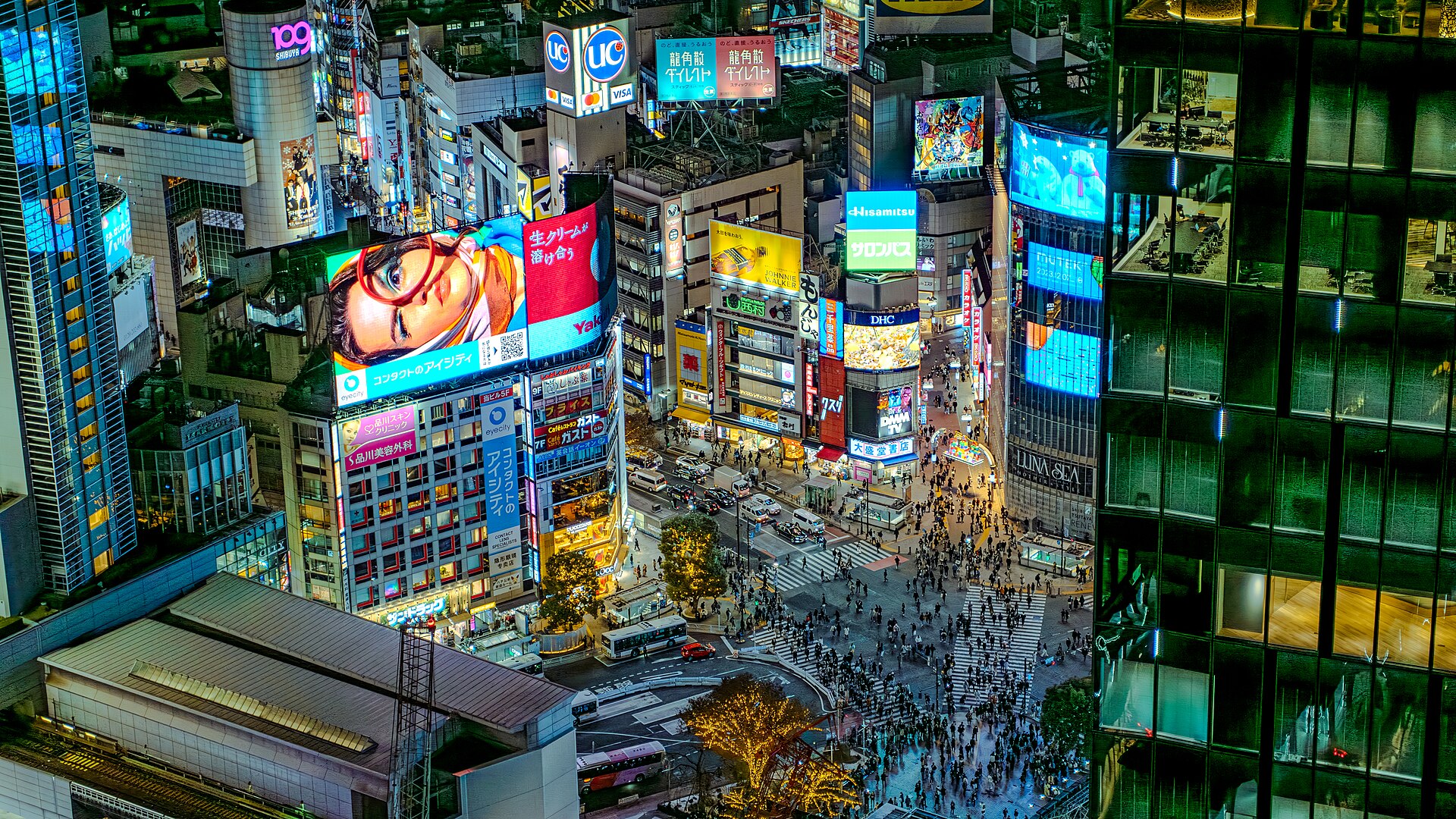

Stand at the kerb outside Shibuya Station and you feel it before you see it: the pressure of a crowd building behind you, the low hum of screens overhead, a bus sighing at the lights. Then every signal turns red for the cars at once, the walking figures light up green on every corner, and hundreds of people step out together. They cross straight, they cross diagonally, they cross towards each other, and somehow nobody collides.
This is the scramble, very likely the most photographed intersection in Japan and the closest thing Tokyo has to a public square. It has no monument at its centre and no plaza worth the name, only paint on asphalt and a sequence of lights. Yet it has become the city's shorthand for itself, a place where the ordinary business of getting from one side of the road to the other turns, several times an hour, into a kind of choreography.
The storyA valley, a station and a dog
Shibuya means, roughly, "bitter valley", and the name is honest about the geography. The district sits in a hollow where several slopes run down to meet, and the station was built at the bottom of them. Rail lines and roads converged on that low point through the twentieth century until the junction in front of the station became one of the busiest pedestrian spaces anywhere. Making every crossing walk at once, rather than letting people trickle across in turns, was a practical answer to a simple problem: there were too many feet and too little pavement.
The meeting point for all of this has long been a small bronze dog. Hachikō, an Akita, walked to the station each evening to meet his owner, the university professor Ueno Hidesaburō, and kept coming back for years after the professor died in 1925. The story made him a national figure in his own lifetime. The statue by the station's Hachikō exit is a post-war recast of the original, and it remains the place Tokyoites name when they say "meet me at Shibuya". Expect a queue of people waiting to photograph it, and a larger crowd simply waiting for friends.
Above the crossing, the buildings are wrapped in screens. Advertising here is less decoration than weather: faces several storeys high, product launches, music videos, the cylindrical 109 tower glowing at the head of Dōgenzaka. In recent years the skyline has climbed, with new towers around the station adding offices, shops and a rooftop observation deck that looks straight down onto the intersection.
It has no monument at its centre, only paint on asphalt and a sequence of lights, yet it has become the city's shorthand for itself.— On the kerb at the Hachikō exit
The walkWatch it, then join it
The crossing rewards two ways of seeing. The first is from above, where the pattern reveals itself: from a height the crowd moves like iron filings around a magnet, threads of people braiding diagonally across the white stripes before the cars surge back in. Several of the buildings facing the intersection have cafés and upper floors with windows over the junction, and the station itself has glassed-in walkways where people stop, phones raised, to watch the tide go out and come back. Inside the Mark City passage linking the station to the Inokashira Line hangs Okamoto Tarō's enormous mural Myth of Tomorrow, a fierce, blazing work about the atomic age, with windows nearby that also frame the scramble.
The second way is from inside it. Wait at the corner by the Hachikō statue, let the crowd gather, and walk when the lights change. Cross diagonally for the full effect. Halfway over you are in the thick of it, people streaming past on both shoulders, the screens booming overhead, and you understand the oddly calm etiquette that makes the whole thing work: nobody hurries, nobody stops dead, everyone simply adjusts by a half-step. Then cross back. Most people do it more than once.
Afterwards, let the crossing push you outward. Center Gai, the narrow pedestrian street running off the far side, is loud, young and fluorescent. Dōgenzaka climbs towards small music bars and late restaurants. Head north and the noise falls away into Cat Street, a lane of cafés and boutiques that winds up towards Harajuku, Omotesandō and the woods of Meiji Jingū.
Through the yearWhen to go
Spring
New students and new office workers fill the city in April, and the crossing has a fresh-start energy. The cherry trees along the Meguro River are an easy detour to the south-west.
Summer
Humid nights, umbrellas against sudden showers, and a sea of white shirts. Rain makes the screens glow twice, once above and once in the wet asphalt.
Autumn
The most comfortable season for lingering on corners. Late October brings dense, costumed crowds and heavy policing; go on another night if you want to move freely.
Winter
Clear, cold evenings and festive illuminations on the trees around the station plaza. New Year's Eve draws crowds that the authorities sometimes restrict, so plan around it.
Know before you goPractical notes
- Use the Hachikō exit. Shibuya Station is a maze of lines and levels. Follow signs for the Hachikō exit and you will surface right at the crossing.
- Evening is the show. The crossing is busy all day, but after dark, when the screens take over, it becomes the scene everyone pictures. Weekday rush hours bring the densest crowds of commuters.
- Photograph with manners. Do not stop in the middle of the road to film; the lights change quickly and drivers expect a clear junction. Shoot from the kerb or from above.
- Mind your belongings, lightly. Tokyo is safe, but this is one of the most crowded spots in the city. Keep bags closed and in front of you, as you would anywhere busy.
- Look up for a view. The rooftop deck on top of the tallest tower by the station looks straight down on the scramble; book ahead around sunset, when slots go fastest.