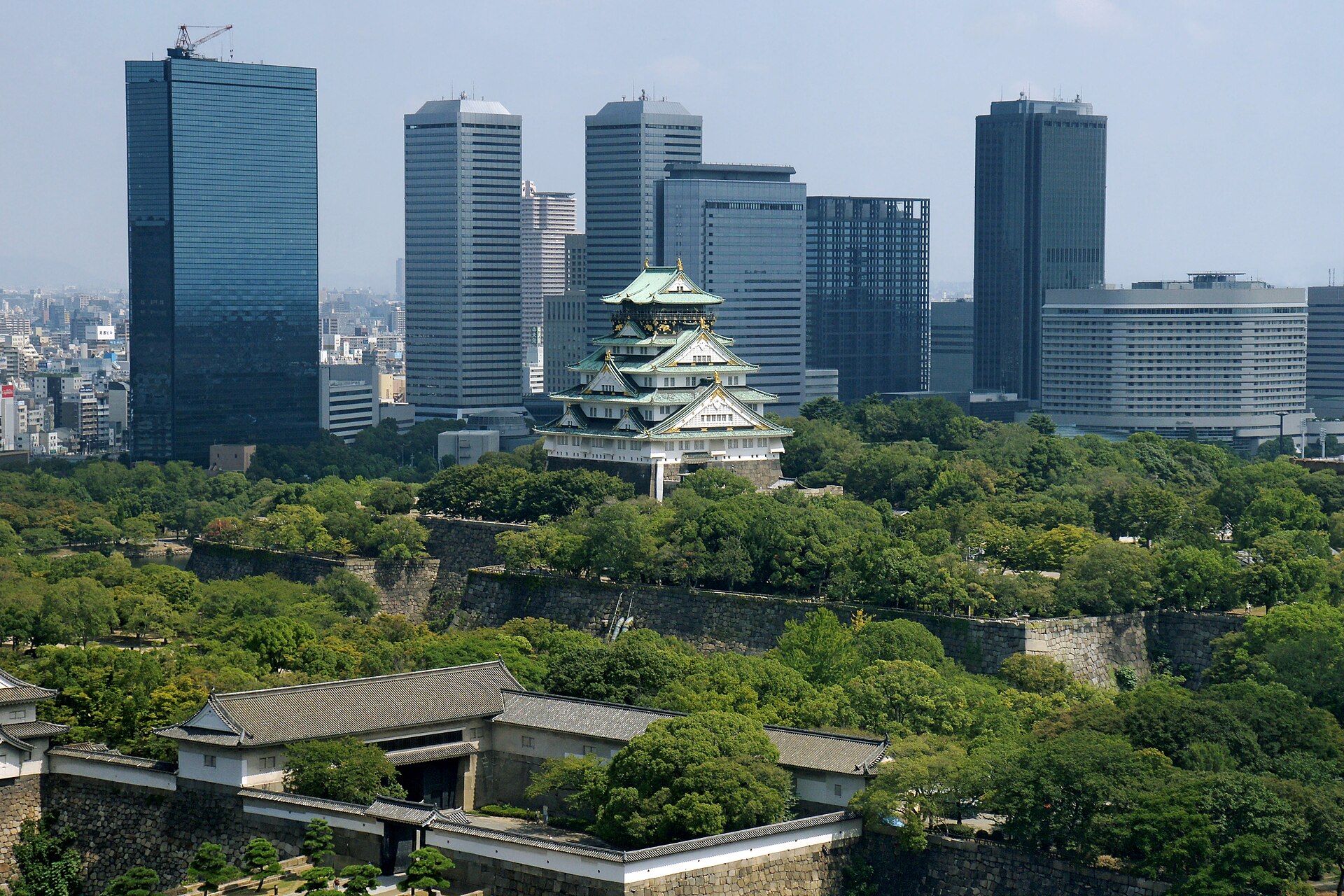

From a high window the castle looks almost impossible: a pale, five-roofed keep trimmed in gold, perched on a plinth of granite, floating in a sea of camphor and pine, while behind it a wall of glass towers catches the same afternoon light. Osaka Castle is the city's oldest argument with itself, between the shogun and the merchant, the warrior's stone and the trader's steel. It has been burned, rebuilt, bombed and restored, and it still holds the centre.
Most visitors come for the keep. Stay for the walls. The real monument here is the ground itself: concentric rings of moat and rampart, stone fitted to stone without mortar, rising in clean curves that were meant to break armies and now simply make you crane your neck.
The storyA castle built twice
Toyotomi Hideyoshi, the general who brought the warring provinces under a single rule, began building here in 1583, on the site of the fortified temple of Ishiyama Hongan-ji. He wanted a seat of power that no rival could ignore, and by the accounts of the day he got one: a keep lacquered in black and glittering with gold, the grandest fortress in the country.
It did not outlast his family. In the sieges of 1614 and 1615 the forces of Tokugawa Ieyasu took the castle and the Toyotomi line ended in its flames. The Tokugawa then did something telling. Rather than simply repair Hideyoshi's work, they buried it, raising a new and larger castle on top. The colossal walls you walk past today are largely theirs, built with stone hauled in by obligated lords from across western Japan; look closely and you will find the carved marks that identified each clan's contribution. Their keep burned after a lightning strike in 1665 and was never replaced under the shoguns.
The tower that stands now dates from 1931, raised in reinforced concrete and paid for by donations from the people of Osaka. Its design borrows from period screen paintings of Hideyoshi's original, its gilded tigers and fish-tailed shachihoko flash from the eaves, and it survived the air raids of the Second World War while much of the city around it did not. A thorough restoration in the late 1990s brought back the brightness of its plaster and gold.
The keep is the souvenir; the stone is the castle.— On the inner moat
The walkGates, stones and the long view
Approach on foot through Osaka-jō Park and the castle reveals itself in stages, as its builders intended. The outer moat is wide and dark, the walls above it sheer. Gates turn you through right angles in boxed courtyards called masugata, where an attacker would have been trapped and watched from the tiled turret halls above. Several of these Edo-period gates and corner towers survive, and they carry more of the old atmosphere than anything inside the keep.
Inside the Sakura-mon gate waits Tako-ishi, the Octopus Stone, the largest single block in the castle's walls: a slab of granite the size of a room, set upright as a statement of what a regime could move. Stand beside it and the scale of Tokugawa ambition becomes physical.
The keep itself is a museum, with scrolls, armour and a sweeping folding-screen narrative of the summer siege. The top floor opens to an observation gallery that circles the tower, looking down on the moats and out to the business district, the Ikoma hills and the low grey sprawl of the city. Afterwards, walk the outer paths to the Nishinomaru Garden on the western enclosure, a broad lawn below the keep, or east to the plum grove, and let the crowds thin out.
Through the yearWhen to go
Spring
Cherry trees bloom along the moats and across the Nishinomaru lawn, and the keep floats above clouds of pink. Glorious, and busy.
Summer
The park turns deep green and humid, cicadas loud in the trees. Go early, before the heat settles into the stone.
Autumn
Ginkgo and maple turn gold and red against the grey walls, and clear air sharpens the view from the top floor.
Winter
Late winter brings the plum grove into blossom, fragrant and far quieter than the cherry season to come.
Know before you goPractical notes
- Give the grounds time. The park are large; allow time to circle at least part of the outer moat rather than heading straight for the keep.
- Set expectations for the interior. The keep is a modern museum with lifts and display cases, not a preserved interior. Its pleasures are the exhibits and the view.
- Find the stones. Look for Tako-ishi inside the Sakura-mon gate and for the clan marks chiselled into the wall faces along the moats.
- Choose your approach. Several rail stations ring the park; arriving from one side and leaving from another turns the visit into a walk.
- Pace the queue. Lines for the keep build through the day, especially in cherry season and on weekends. Morning is calmer.