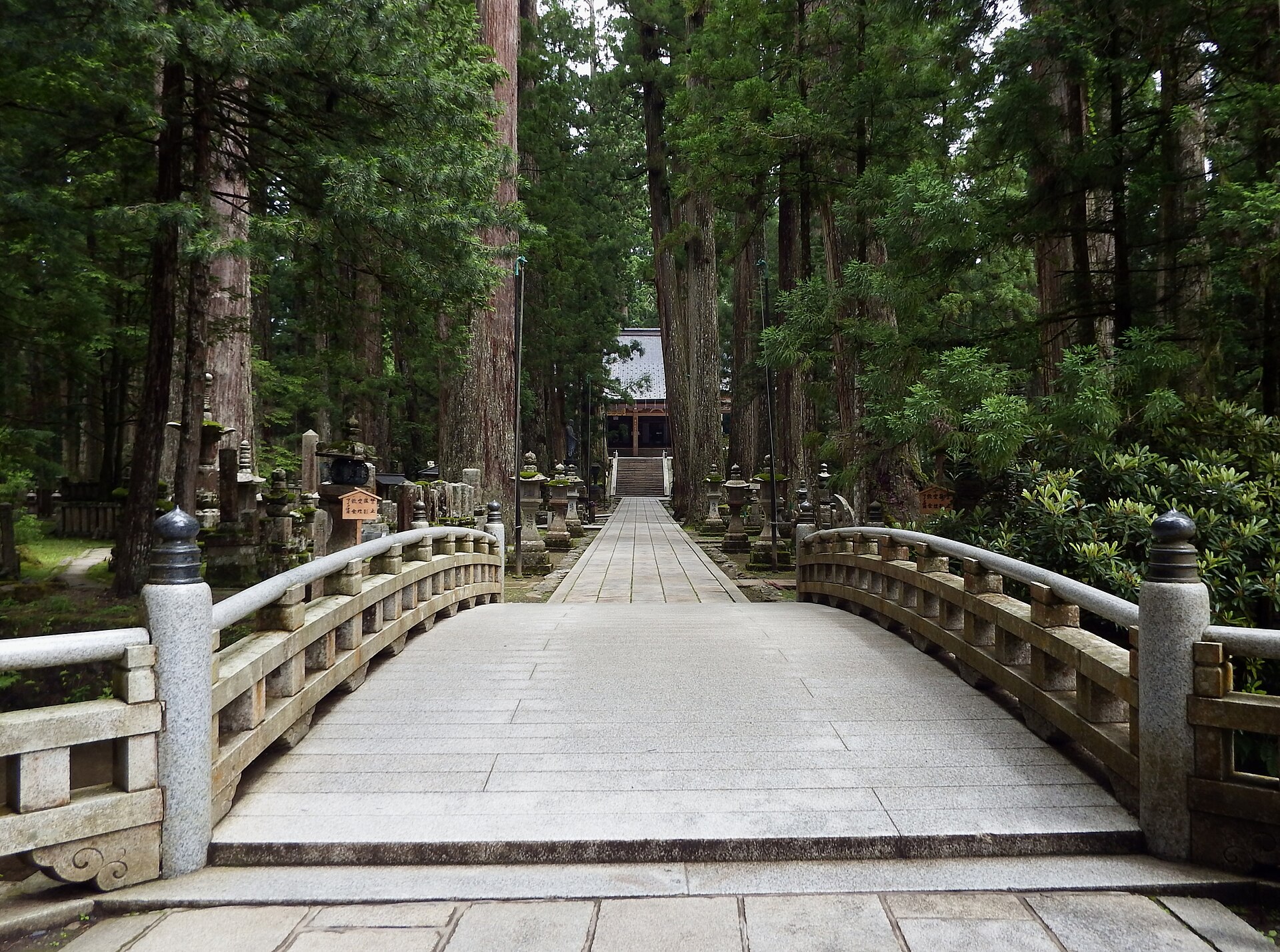

The path begins at a small bridge on the edge of town and simply keeps going. Within a few hundred paces the shops and temple lodgings of Kōyasan fall away, the cedars close overhead, and the light turns the colour of deep water. On either side, as far into the trees as you can see, stand gravestones, pagodas and lichen-spotted lanterns, so many that the forest seems built of them. This is Okunoin, and it is less a cemetery than a city of the remembered.
It sits on Mount Kōya, a high, cool basin in the mountains of northern Wakayama, some eight hundred metres above sea level. The mountain is the home of Shingon Buddhism, and Okunoin is its innermost sanctuary: the place the whole monastic town ultimately points toward. Together with the rest of Kōyasan, it forms part of the Sacred Sites and Pilgrimage Routes in the Kii Mountain Range, inscribed as a UNESCO World Heritage Site in 2004.
The storyA teacher who never left
In 816, a decade after returning from study in Tang China, the monk Kūkai, known posthumously as Kōbō Daishi, was granted this remote mountain to found a monastery. He became one of the towering figures of Japanese history: a teacher, calligrapher and engineer whose name still attaches itself to temples, wells and legends across the country. In 835 he withdrew into meditation on the mountain, and his followers hold that he never died. He remains, they believe, in eternal meditation inside the Gobyō, his mausoleum at the far end of the path, waiting with compassion for the coming of the future Buddha.
The belief is not merely historical. Monks still carry meals to the mausoleum every day, a quiet procession that treats the Daishi as a living presence. And because so many wished to rest near him, Okunoin grew over the centuries into the largest cemetery in Japan, with well over two hundred thousand graves and memorials. Feudal lords who fought each other in life lie a short walk apart; the memorials of Oda Nobunaga and of the Toyotomi family are here, among thousands of samurai clans, poets, monks and ordinary families. More recent additions include monuments raised by modern companies for their employees, some of them startlingly literal in design.
Rivals who fought across a century of war now share the same shade, a few cedar trunks apart.— On the long approach
The walkFrom the first bridge to the last
The traditional route starts at Ichi-no-hashi, the first bridge, where pilgrims bow before crossing. From there the stone path runs for about two kilometres beneath cryptomeria cedars, many of them several centuries old and broad enough that two people could barely link arms around the largest. Moss climbs the bases of the gravestones and softens the carved faces of small stone Jizō, many dressed in red bibs and caps by those who come to pray for children. The sound is mostly birdsong, footsteps and, in rain, a steady dripping from the canopy.
Near the end, a row of bronze Jizō statues stands beside a stream, and visitors ladle water over them in memory of the dead. Then comes Gobyōbashi, the granite bridge in our photograph. Beyond it lies the most sacred ground on the mountain. Pilgrims bow again before crossing, hats come off, and photography and eating are not permitted on the far side. The path leads straight to the steps of the Tōrō-dō, the Lantern Hall, where thousands of lanterns hang in dim rows, some of them said to have burned without interruption for close to a thousand years. Behind the hall is the Gobyō itself, approached in silence.
The walk back is when the place settles in. Take a side path between the graves, where the ground rises and falls in mossy terraces and the stones grow older and more weathered the further you go. There is no single view to collect here, only an accumulation of small encounters: a stone with a family crest still sharp, a pagoda leaning gently into a tree root, a fresh bunch of flowers on a grave three hundred years old.
Through the yearWhen to go
Spring
Spring arrives late at this altitude, so cherry blossom around the town often follows the lowlands by a few weeks. Fresh cedar growth brightens the path.
Summer
The mountain stays noticeably cooler than Osaka or Kyoto, and the canopy keeps the path shaded. Expect rain, and enjoy it: the moss is at its most vivid.
Autumn
Maples flare red among the dark cedars, especially around the temples of the town. Mornings turn crisp; bring a layer.
Winter
Cold and often snowy. The lanterns and gravestones wear caps of white, visitors thin out, and the hush becomes absolute.
Know before you goPractical notes
- Start at Ichi-no-hashi. Buses run closer to the mausoleum, but the full walk from the first bridge is the point. Save the bus for the return if your legs need it.
- Stay the night. Many of Kōyasan's temples take guests in shukubō, with vegetarian shōjin ryōri dinners and the option to join the monks at morning prayers.
- Mind the far side of Gobyōbashi. No photography, food or drink beyond the bridge. Speak quietly, remove your hat and follow the lead of the pilgrims around you.
- Dress for the mountain. Temperatures here run well below the cities in the valley. Comfortable shoes matter; the stone path can be slick after rain.
- Walk at dusk. As evening falls the lanterns along the path glow, and the cemetery takes on a very different, deeply calm character. Several temples organise guided night walks.