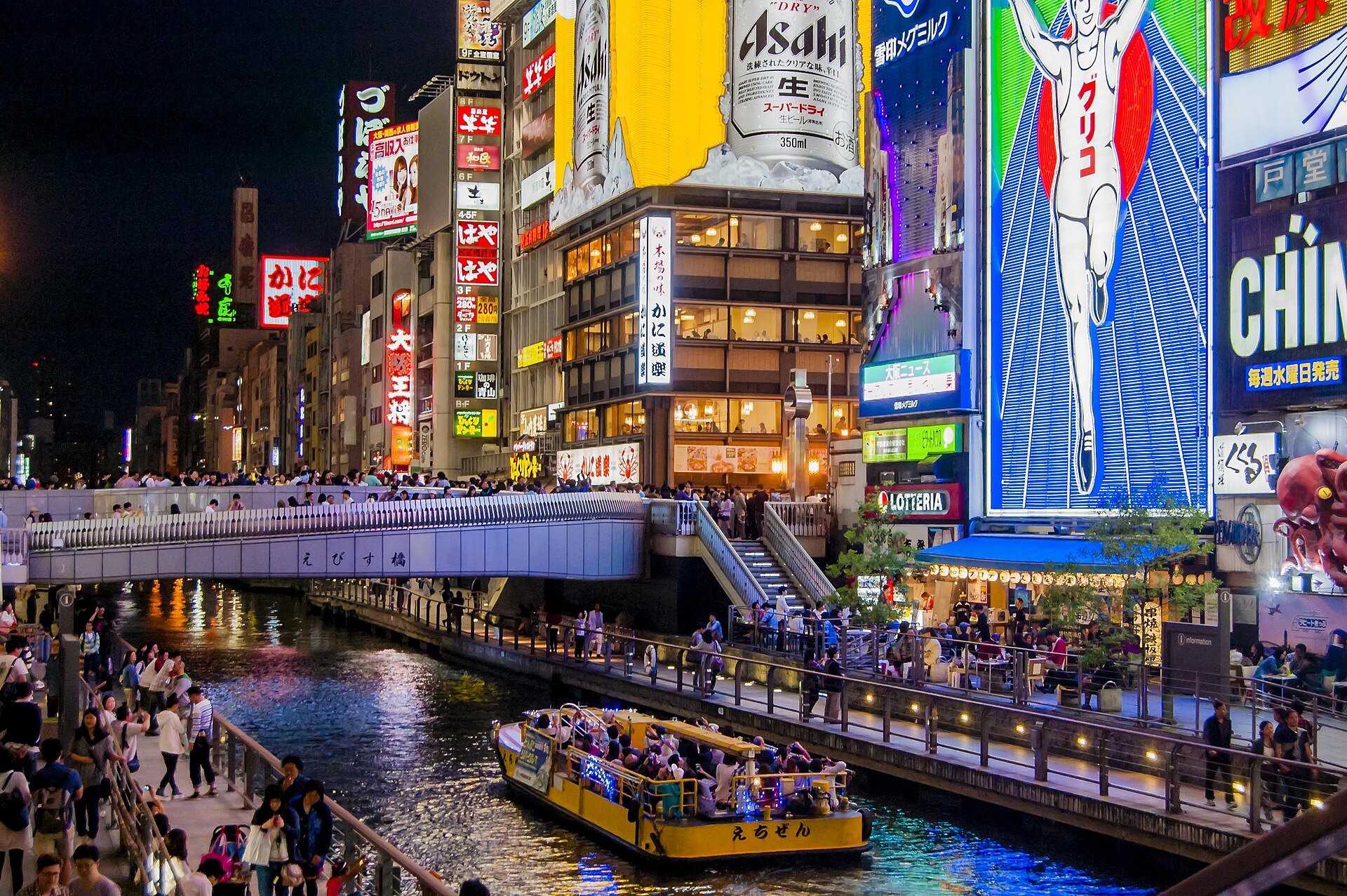

Stand on Ebisu-bashi after dark and Osaka arrives all at once. A running man in a white vest throws his arms up across a wall of blue light. A beer can the height of a house glows gold. Below, the canal takes every colour and breaks it into ribbons, and a boat full of upturned faces drifts through the reflection. Somewhere close, batter hisses on hot iron. This is Dōtonbori, and it has no interest in being quiet.
Tokyo has its grand crossings and its polished districts, but Dōtonbori belongs to a different temperament. Osaka is a merchant city, proud of its appetite and its sense of humour, and this short stretch of canal-side street is where both are turned up to full volume. It is gaudy on purpose. It is also, once you learn to read it, one of the most affectionate places in Japan.
The storyA canal dug for trade, kept alive by theatre
The canal takes its name from Yasui Dōton, a local merchant who began cutting the waterway in the early seventeenth century to link the city's rivers and carry goods. He did not live to see it finished; he died in the Siege of Osaka in 1615, and his cousin Yasui Dōboku saw the work through. The new channel, and the district that grew along it, took Dōton's name. Within a few years the authorities gathered the city's playhouses on the canal's south bank, and Dōtonbori became a theatre quarter.
For much of the Edo period this was the heart of popular entertainment in Osaka. Kabuki and the puppet theatre that would become bunraku drew crowds who needed feeding before, during and after the performance, and teahouses and food stalls crowded in to oblige. The pairing of stage and table set the character of the place. The playhouses have mostly gone, the arched façade of the Shōchikuza standing as a reminder, but the hunger they created never left.
That hunger has a word. Osakans speak of kuidaore, roughly "to eat yourself into ruin", and Dōtonbori is its spiritual home. The neon followed in the twentieth century. The Glico running man first appeared here in the 1930s and has been rebuilt several times since; for many Japanese he is as much a symbol of the city as its castle.
It is gaudy on purpose, and once you learn to read it, one of the most affectionate places in Japan.— On Ebisu-bashi
The walkSigns, steam and the slow water
Begin on Ebisu-bashi, the bridge at the centre of everything, where the crowd turns to face the Glico sign and lifts phones in unison. Locals once nicknamed it Hikkake-bashi, the "pick-up bridge", for the flirting that went on here, and on a warm night it still has the air of a promenade. Then walk the street itself, which runs parallel to the canal on its south side, and look up. The restaurant signs are sculptures as much as advertisements: a giant mechanical crab slowly waving its legs above a seafood house, a coiling dragon over a ramen shop, a grinning red octopus. They exist to make you laugh, and then to make you hungry.
Follow your nose. Takoyaki, balls of batter folded around pieces of octopus and turned with quick picks in dimpled iron pans, are the street's signature, eaten scalding from paper boats under a lacquer of sauce, mayonnaise and wavering bonito flakes. Okonomiyaki, the savoury cabbage pancake Osaka considers its own, is often cooked on a griddle set into your table. Kushikatsu, skewers fried in a light crumb, come with a shared pot of sauce and one firm rule: dip once, and never again after biting.
When the street gets too loud, take the stairs down to the Tonbori River Walk, the paved promenade at water level. The noise softens, the neon hangs overhead like weather, and the tour boats nose past close enough to wave at. A few steps south of the main drag, the lanes of Hōzen-ji Yokochō offer a different mood entirely: flagstones, lanterns and a small temple whose statue of Fudō Myōō is so thickly furred with moss, from generations of worshippers splashing it with water, that its features have softened into green.
Through the yearWhen to go
Spring
Mild evenings make the River Walk a pleasure, and the city's cherry blossom season fills Osaka with an easy, celebratory mood.
Summer
Hot and humid, but the canal catches whatever breeze there is, and a cold drink on the water's edge is the right reply to the heat.
Autumn
The finest season for long walks and longer dinners: clear air, comfortable nights and the neon at its sharpest.
Winter
Cold, crisp and early dark, which means more hours of glow. Steaming takoyaki in gloved hands make the most sense now.
Know before you goPractical notes
- Come after dark. By day Dōtonbori is merely busy; at night it becomes itself. Arrive at dusk to watch the signs come up one by one.
- Eat standing, then sitting. Graze the street stalls first, then settle into an okonomiyaki or kushikatsu counter for a proper meal.
- Mind the eating etiquette. Walking while eating is frowned on in much of Japan; finish your takoyaki beside the stall where you bought it.
- Expect crowds on the bridge. Ebisu-bashi is the busiest point. Keep moving, step aside for photographs and keep a hand on your bag.
- Look beyond the main street. Hōzen-ji Yokochō and the side lanes towards Namba hold quieter bars and older, smaller restaurants.