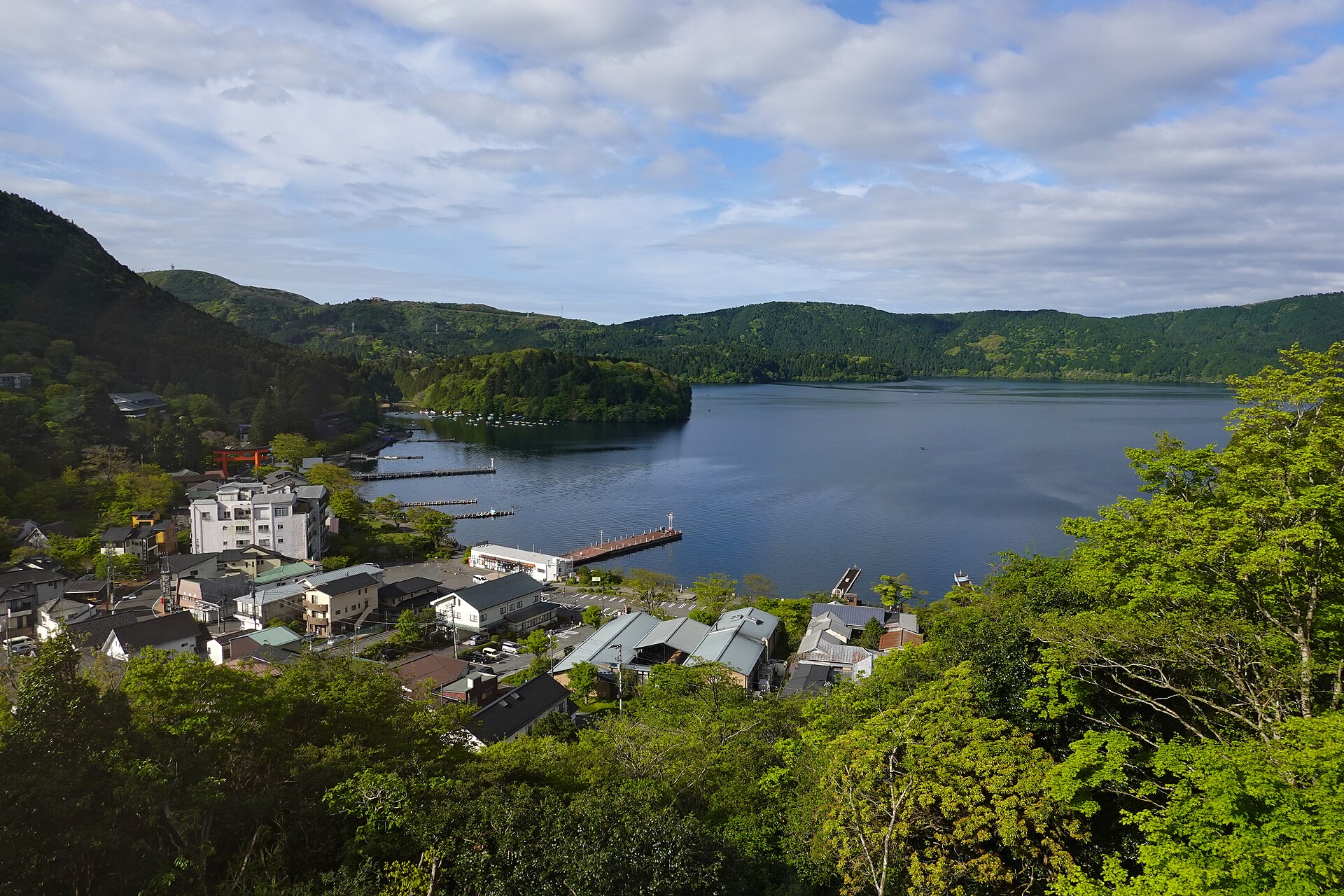

Climb out of the steaming valleys of Hakone and the air changes. It cools, sharpens, takes on the resin smell of cedar, and then the trees part and there is water: a long, dark-blue lake lying in the hollow of a volcano, its far shore folding into ridge after green ridge. Lake Ashi is the quiet centre of the Hakone loop, the place where travellers stop hurrying and start looking.
On paper it is a stop between a mountain railway and a ropeway. In practice it is the part of the day people remember: the slap of water against a wooden pier, a vermilion gate standing in the shallows, the moment the clouds lift off the western ridges and the snow cap of Mount Fuji appears above the hills as if it had been there all along. Which, of course, it had.
The storyA lake made by fire
Hakone is a volcano that has been collapsing and rebuilding itself for hundreds of thousands of years. Lake Ashi fills the southwestern corner of its caldera, the great basin left when the old summit fell in on itself, and took its present shape roughly three thousand years ago, when eruptions and landslides from the central cone of Kamiyama sealed off a river valley and let the water rise. The fumaroles of Ōwakudani, still hissing a few kilometres to the north, are a reminder that the story is not finished.
People have long given the lake a temperament. Local legend tells of a nine-headed dragon that terrorised the villages on its shore until a priest subdued it and it became the lake's guardian. The dragon is still honoured at Kuzuryū-jinja by the water's edge, and at Hakone Shrine, whose cedar-shaded precinct climbs the hill above Moto-Hakone and whose lakeside torii has become one of the most photographed gates in Japan.
The southern shore also sat on the Tōkaidō, the great road between Edo and Kyoto. The shogunate kept a checkpoint here at Hakone, where travellers' papers were inspected and women leaving the capital were scrutinised with particular care. The barrier has been carefully reconstructed, and the avenue of towering cedars planted along the old road in the Edo period still shades the path between Moto-Hakone and Hakone-machi, their trunks thick as a doorway and furred with moss.
The lake does not perform. It waits, and lets the mountain decide whether to appear.— On the shore at Moto-Hakone
The walkShore, cedar and water
Most visitors reach the lake at Moto-Hakone, a small, tidy lakeside town of guesthouses, cafés and boat piers tucked into the southeastern corner. From here a lakeside path leads north through the trees to Hakone Shrine. The main hall sits up a flight of stone steps under cedars so tall the light arrives green; below it, the torii stands with its feet in the lake, and on calm mornings it doubles itself perfectly in the water. Expect a queue for the classic photograph at the gate, and expect it to move gently, everyone taking their turn.
Walk the other way, south and then west, and you join the old Tōkaidō under its cedar canopy. The path is soft underfoot and noticeably cooler than the open shore. It brings you to the Hakone checkpoint and on to Hakone-machi, where the wooded promontory of Onshi Hakone Park, once the grounds of an imperial villa, offers one of the finest lakeside views of Fuji when the weather allows.
Then take to the water. The sightseeing ships that cross the lake are dressed, unapologetically, as galleons, all painted hulls and rigging. It is easy to be snobbish about them and hard to stay that way once you are on deck, the wind coming off the lake and the shoreline sliding past. They run between the southern piers and Tōgendai at the northern tip, where the Hakone Ropeway rises over the ridge toward the sulphur vents of Ōwakudani. Done in this direction or the reverse, the crossing is the hinge of the classic Hakone circuit.
Through the yearWhen to go
Spring
Cherry blossom comes late up here, after Tokyo's has fallen, and by May the hillsides are a hundred shades of new green.
Summer
The lake is a cool retreat from the lowland heat, though haze and cloud often hide Fuji. Hydrangeas crowd the tracks of the mountain railway below.
Autumn
Maples and beech turn the ridges rust and gold, and clearer air brings the mountain back into view.
Winter
Cold, crisp and quiet. Dry days give the most dependable views of a snow-capped Fuji over the water.
Know before you goPractical notes
- Go early. Morning brings the stillest water for reflections and the shortest wait at the shrine's lakeside torii.
- Fuji is a gift, not a promise. The mountain hides behind cloud on many days, especially in summer. Treat a clear view as a bonus and the lake as the point.
- Think in a loop. Train, cable car, ropeway, boat and bus link into a circuit through Hakone. Pick a direction and let the lake be the long, slow middle of the day.
- Pack a layer. The lake sits high in the hills and is markedly cooler and windier than Tokyo, especially on deck.
- Stay the night. Day-trippers leave by late afternoon. An overnight stay in a Hakone ryokan with an onsen bath gives you the lake at dusk and again at dawn.