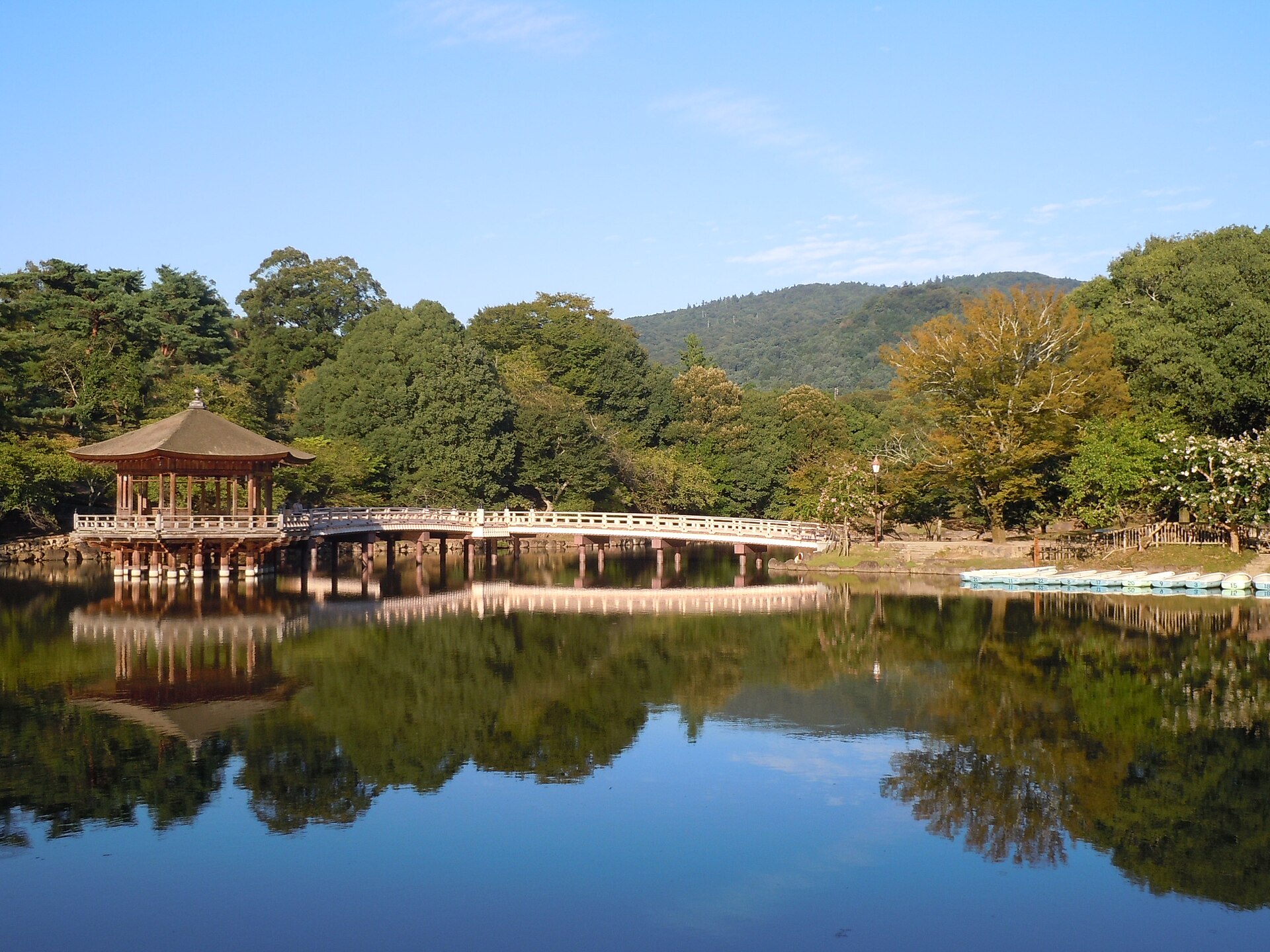

Most parks are made around something. Nara Park was made around everything at once: a great bronze Buddha, a five-storey pagoda, a shrine hung with thousands of lanterns, an ancient forest and a herd of deer that has wandered these lawns for longer than anyone has kept count. Step out of the station and within minutes the city gives way to open grass, cedar shade and the soft click of hooves on gravel.
It is a park in the loosest sense. There is no single gate and no fence around the whole. The grounds spill from the edge of the modern town up into the hills, folding temple precincts, ponds and meadows into one long, unhurried landscape. You do not visit Nara Park so much as drift through it, and the best days here are the ones with no plan beyond the next patch of shade.
The storyA capital, and its messengers
For most of the eighth century Nara was the seat of the imperial court, a city laid out on a Chinese-style grid and built to outlast a single reign. The court eventually moved on, but the great religious houses it had sponsored remained, and the land around them stayed sacred. Tōdai-ji, Kōfuku-ji and Kasuga-taisha still anchor the park today, and the public grounds that link them were formally laid out in the Meiji era, making this one of the oldest parks in the country.
The deer predate all of it in spirit. Legend holds that the deity enshrined at Kasuga-taisha arrived in Nara riding a white deer, and ever since the animals have been treated as divine messengers. They are now protected as a national natural monument. More than a thousand of them roam freely, sleeping in the woods at night and drifting down to the lawns by day, where they cross roads with the calm of commuters and stand in the shade of temple gates as if waiting to be let in.
Many have learned to bow. Dip your head to a deer holding out for a cracker and there is a fair chance it will dip its head back, a small exchange of manners that never quite stops being delightful.
You do not visit Nara Park so much as drift through it.— On the lawns below Tōdai-ji
The walkFrom the Great Buddha to the floating hall
Begin at Kōfuku-ji on the western edge of the park, then follow the crowds north-east to Tōdai-ji. Its Great Buddha Hall is among the largest wooden buildings in the world, and the bronze figure inside, seated in the half-dark with one palm raised, is scaled to make every visitor feel briefly very small. Walk the approach slowly; the guardian kings flanking the Nandaimon gate are worth a long look on their own.
From there, turn east and uphill into the forest. The path to Kasuga-taisha is lined with stone lanterns furred with moss, hundreds upon hundreds of them, and the shrine's vermilion corridors are hung with bronze lanterns donated over centuries. The air cools beneath the trees, and the Kasugayama primeval forest beyond has been protected from felling for more than a thousand years.
Then come back down toward Sagi-ike, the quiet pond in the photograph above. Out on the water stands Ukimidō, an open wooden hall on stilts reached by a gently arched bridge. On a still morning the whole structure doubles itself in the water, and the rowing boats tied along the bank sit untouched. This is the part of the park most visitors miss, and the one many return to.
Through the yearWhen to go
Spring
Cherry trees bloom across the lawns and around the ponds, and the deer graze beneath a pale, drifting haze of petals.
Summer
Fawns are born in early summer and soon appear, spotted and unsteady, at their mothers' sides. Come early; the afternoons are heavy and humid.
Autumn
Maples and ginkgo colour the forest edges, and the stags carry full antlers until they are sawn off at the traditional antler-cutting ceremony.
Winter
Thin crowds and clear light. In January the grass of Wakakusa-yama is set alight in a single evening, a burning hillside visible across the city.
Know before you goPractical notes
- Feed only shika-senbei. The rice crackers sold by vendors around the park are the only food meant for the deer. Never offer anything else, and keep snacks and plastic bags out of sight.
- Respect the animals. The deer are wild and can nip, butt or kick, especially stags in autumn and mothers with fawns. Hand crackers over promptly rather than teasing, and show empty palms when you are done.
- Start early. Tour groups arrive mid-morning. Before then, the lawns belong to the deer and the walkers, and Tōdai-ji feels like a place of worship again.
- Wear proper shoes. The Kasuga-taisha approach climbs over gravel and uneven stone, and a full loop of the park easily runs to several kilometres.
- Mind the temple rules. Each of the major sites keeps its own grounds and admission arrangements within the park. Remove hats inside halls and follow any signs about photography.