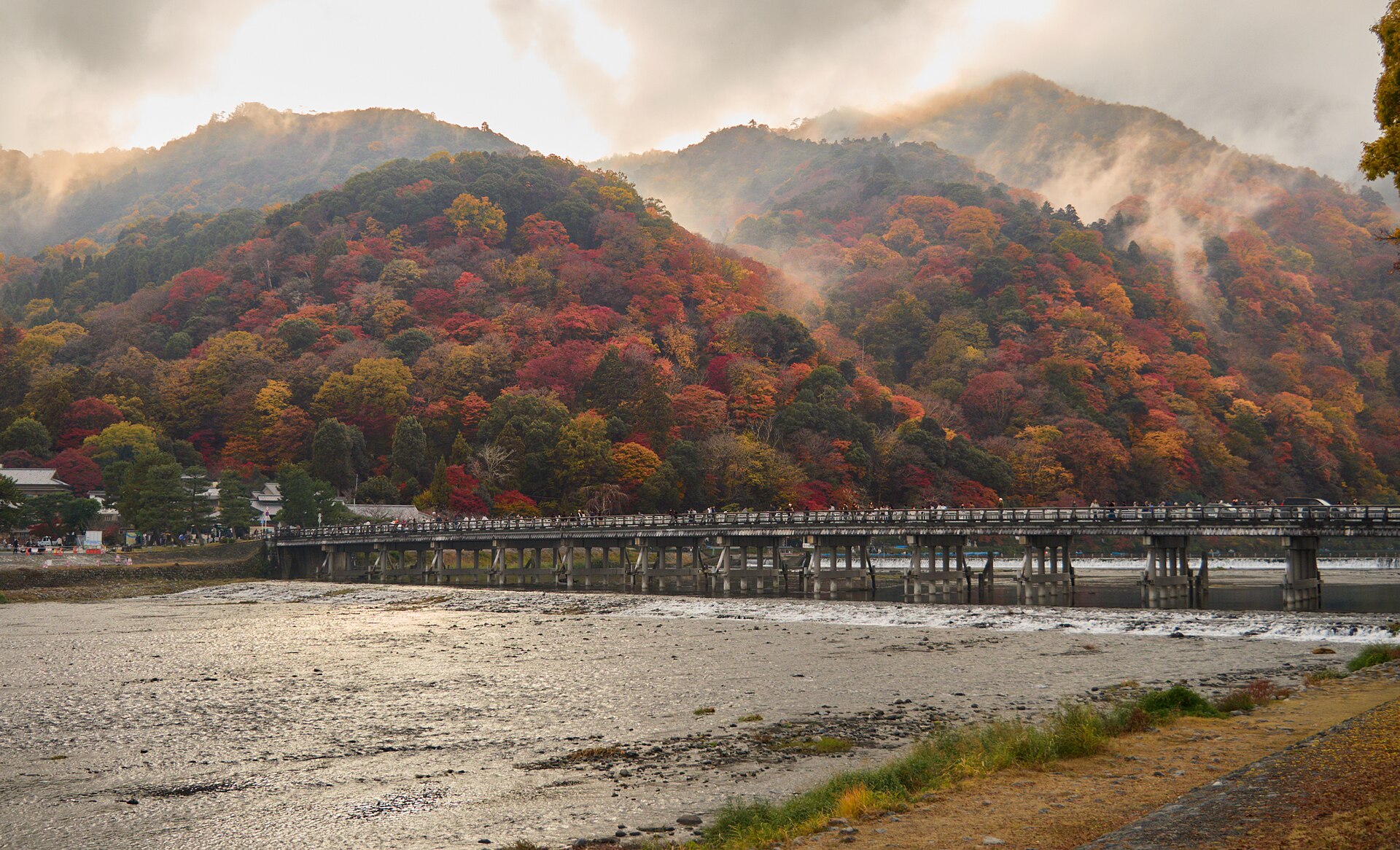

Arashiyama means "storm mountain", and on the right November afternoon it earns the name: cloud pours down the slopes in slow grey ribbons, the maples beneath burn crimson and amber, and a long bridge stitches the two banks together across a river that barely seems to move. This is the western edge of Kyoto, where the city thins out into hills, and where it has come to breathe for more than a thousand years.
It is not a quiet place by day. Coaches unload by the bridge, rickshaw pullers call out from the corners, and the main street smells of grilled rice crackers and matcha soft-serve. But Arashiyama rewards anyone willing to walk a little further, start a little earlier or stay a little later. Step a few lanes back from the river and the district shows its older shape: a landscape of temples, villas and bamboo arranged around the view of one modest, endlessly painted mountain.
The storyA retreat for emperors
In the Heian period, when Kyoto was the imperial capital, the nobility built villas out here to escape the city and compose poems about the seasons. Boating parties drifted on the river beneath the hills, and the court treated the changing colour of Arashiyama as an event worthy of verse. That habit of looking, of turning scenery into ceremony, is the thread that runs through everything you will see.
The bridge at the centre of every photograph is Togetsukyō, the "Moon Crossing Bridge". Tradition credits the name to Emperor Kameyama in the thirteenth century, who remarked that the moon, passing overhead on a clear night, seemed to be crossing it. The present structure is modern, built with a concrete core, but its wooden railings and low profile were designed to keep the old silhouette intact against the hills.
A short walk inland stands Tenryū-ji, the great Zen temple founded in 1339 by the shōgun Ashikaga Takauji in memory of Emperor Go-Daigo. Its garden, attributed to the priest and designer Musō Soseki, is one of the finest in Japan: a pond edged with stones and pines that borrows the forested slopes behind as its backdrop. Tenryū-ji is part of the UNESCO World Heritage listing for the historic monuments of ancient Kyoto, and it is the clearest lesson in Arashiyama's central trick. The best gardens here do not stop at their walls.
The best gardens here do not stop at their walls; they finish on the mountain.— On the Sōgen pond
The walkBridge, bamboo and the quiet north
Start at the river. Stand on the north bank, a little downstream of the bridge, and you have the view in the photograph above: the shallow weir beyond it throwing up a line of white water, Togetsukyō running low and long, and the mountain filling the sky behind. Then cross. The far bank is quieter, with a riverside path, rental rowing boats in the warmer months, and a steep climb up to the Iwatayama Monkey Park, where the macaques roam free and the city spreads out below.
Back on the north side, the path behind Tenryū-ji leads into the bamboo grove of Sagano. The stalks rise far overhead and close into a green vault, and when the wind moves through them the sound is a soft, hollow knocking, like distant wooden chimes. In the middle of the day it is crowded shoulder to shoulder; at first light it is one of the most transporting walks in Japan. At the top of the grove sits Ōkōchi Sansō, the hillside villa and garden of the period-film star Ōkōchi Denjirō, whose paths wind up to views over the city and across to Mount Hiei.
Before you go on, look in at Nonomiya-jinja, the small shrine beside the grove whose torii of dark, unbarked wood appears in The Tale of Genji. Then keep heading north into Sagano proper, and the crowds fall away quickly. Jōjakkō-ji climbs a mossy slope beneath maples; Giō-ji is little more than a thatched hall in a garden of moss so deep it looks like velvet. This is the part of Arashiyama that most visitors never reach, and the part you will remember.
Through the yearWhen to go
Spring
Cherry trees bloom along the riverbanks and dot the lower slopes, softening the mountain in pale pink.
Summer
Deep green and humid. In the evenings, cormorant fishing by firelight on the river revives an old courtly entertainment.
Autumn
The great season. The maples peak from mid to late November, and the hills look exactly as they do above.
Winter
Bare, clear and calm. A rare snowfall turns the bamboo and temple roofs into ink paintings.
Know before you goPractical notes
- Go early. The bamboo grove is open ground and fills fast. Arrive soon after sunrise and you may have it almost to yourself.
- Walk north, not just along the river. The temples of Sagano are a gentle stroll beyond the grove and far calmer than the main street.
- Choose your train. Three railways serve the area, each arriving at a different station; plan your walk so you leave from a different one than you arrived at.
- Make a day of it. Arashiyama pairs naturally with the scenic Sagano train and the river boats down the Hozu gorge from Kameoka.
- Mind the monkeys. At Iwatayama, do not stare at the macaques or carry food openly; feed them only from inside the hut, as directed.
- Wear proper shoes. The best of Arashiyama is uphill: the monkey park, Ōkōchi Sansō and Jōjakkō-ji all involve stone steps.