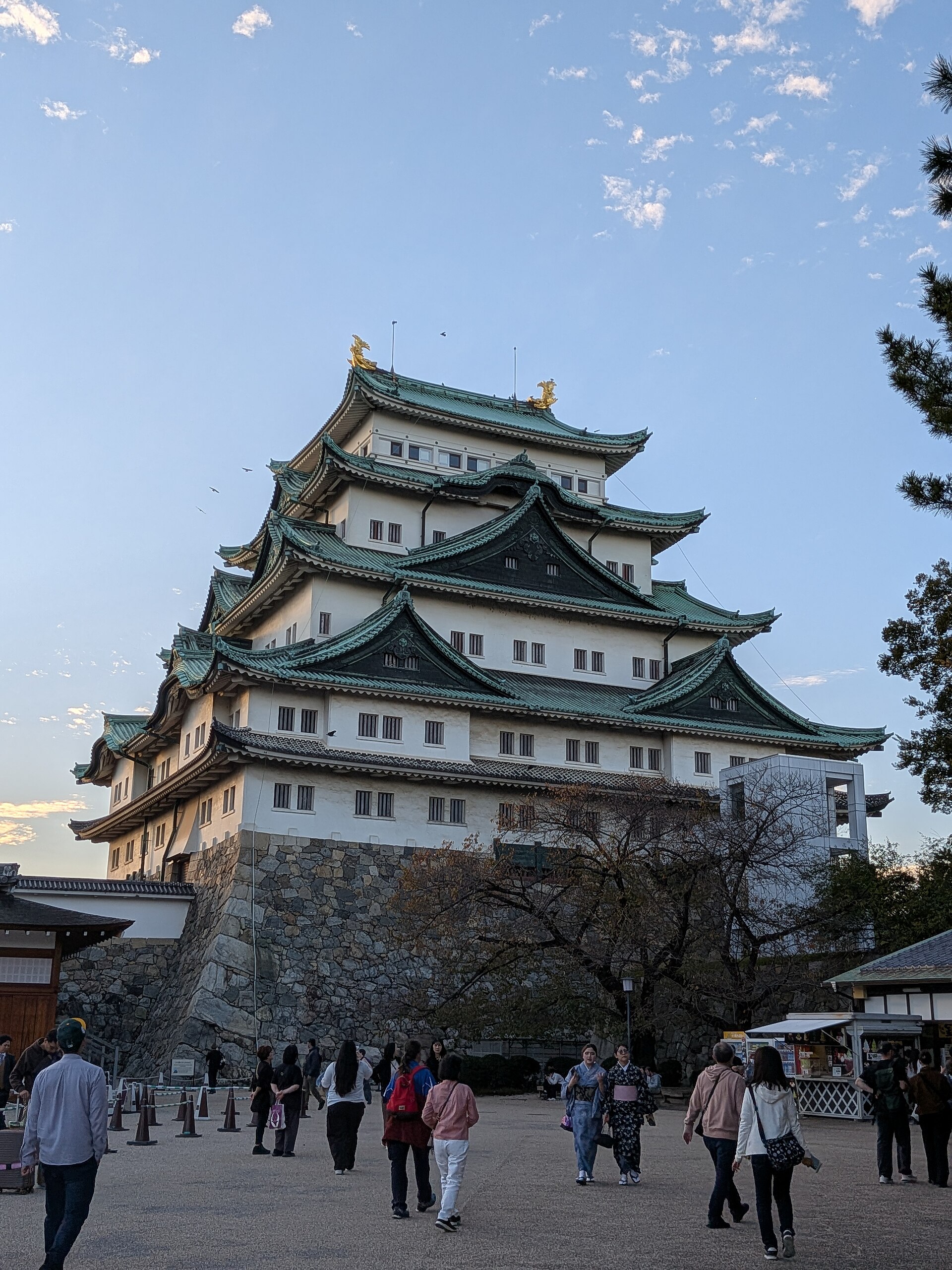

Walk in through the main gate and the keep arrives in stages: first the stone, a sloped cliff of granite blocks fitted without mortar; then the white plaster, tier upon tier; then the copper roofs, weathered to the soft green of a sea-washed bottle. Last of all, if the sun is low, a flash of gold on the ridge. Those are the kinshachi, two gilded creatures with the heads of tigers and the tails of carp, and they have been Nagoya's emblem for four centuries.
Nagoya rarely makes the first draft of a Japan itinerary. It is a working city, a place of factories and trade fairs, passed through at speed on the way between Tokyo and Kyoto. That is precisely why its castle rewards the people who stop. The grounds are broad and unhurried, the palace inside them is one of the finest pieces of traditional carpentry built in modern Japan, and the whole complex tells a sharper story about power than many of the country's prettier fortresses.
The storyA fortress built by its rivals
Tokugawa Ieyasu ordered the castle in 1610, a decade after his victory at Sekigahara had made him master of Japan. It guarded the Tōkaidō road and the western approach to Edo, and it became the seat of the Owari branch of the Tokugawa, one of the three senior houses from which a shogun could be chosen. The construction was a political act as much as a military one. Ieyasu required the lords of western Japan, many of them recent enemies, to build the stone walls at their own expense. Look closely at the blocks and you can still find carved marks left by their work crews, small signatures of men who were paying, in stone, for their own loyalty.
For more than three hundred years the castle stood largely as built. The keep and the Honmaru Palace were recognised as national treasures in the twentieth century, and both burned in air raids in May 1945. A handful of structures survived the fire, among them three corner turrets and several gates, and they are worth seeking out as the oldest buildings on the site. The keep you see today was rebuilt in reinforced concrete in 1959, a faithful silhouette on the original stone base, complete with a new pair of golden shachihoko.
The palace took longer. Using the detailed photographs and measured drawings made before the war, craftsmen spent years reconstructing it in Japanese cypress with traditional joinery, and it was fully reopened in 2018. It is not a replica so much as a resurrection: the same rooms, the same proportions, the painted screens copied from the originals that had been carried to safety before the bombs fell.
The keep is the castle's shout. The palace is its whisper, and the whisper is what stays with you.— In the Honmaru Palace
The walkFrom the moat to the gilded rooms
Begin outside the walls. The moats are deep and wide, some still holding water, others long dry and softened by grass and trees. Walk part of the circuit for the classic composition of keep rising over stone and moat, then enter through the main gates, which turn at right angles in the old defensive manner so that no attacker could run straight in.
The forecourt below the keep is where the scale lands. The stone base leans back at an angle that looks almost gentle until you stand at its foot. Above it the keep climbs in five tiers, triangular gables stacked one over another, the white walls pierced by small barred windows. On one flank, a modern lift tower is bolted to the stone, a frank reminder that this is a post-war building. The concrete keep's interior has been closed to visitors since 2018 while the city pursues a long-delayed plan to rebuild it in timber, so treat it as a monument to look at rather than climb.
The palace, by contrast, you must enter. Shoes come off at the door, and the first thing you notice is the scent of new cypress, clean and faintly sweet. The corridors are long and dim, the floors smooth under socked feet. Then the screens begin: tigers prowling through bamboo, pines spreading across walls of gold leaf, flowers and birds in the restrained style of the Kanō school painters. The rooms grow more elaborate as you move inward, because rank in Edo Japan was measured in distance from the lord. The innermost chambers, built for the shogun's visits, have coffered ceilings so intricate that people tend to stand in the doorway with their heads tilted back, saying nothing at all.
Leave time for the outer grounds and the Ninomaru garden, quieter and greener, where the castle's defensive purpose gives way to ponds, stones and pines. Near the main gate, a street of reconstructed Edo-style buildings serves Nagoya's own cooking: grilled eel over rice in the local hitsumabushi manner, pork cutlet under dark miso, flat kishimen noodles.
Through the yearWhen to go
Spring
Cherry trees fill the moats and line the paths, and the white keep above pink blossom is the image Nagoya puts on its postcards. Expect crowds and lantern-lit evenings.
Summer
Hot and humid, as the Nōbi plain always is. Come early, retreat into the cool cypress of the palace at midday, and save the grounds for the long evening light.
Autumn
Our favourite season here. Clear skies, low sun on the copper roofs, and the trees around the forecourt turning russet, as in the photograph above.
Winter
Thin crowds and crisp air. On the rare morning of snow the green roofs turn white and the golden carp stand out like embers.
Know before you goPractical notes
- Prioritise the palace. If time is short, give it to the Honmaru Palace rather than the grounds. It is the finest thing on the site and the only major interior you can enter.
- Wear easy shoes and good socks. You remove your shoes at the palace entrance and walk its polished floors in socks, so slip-ons save time at the door.
- Find the original buildings. The surviving corner turrets and gates date from the early seventeenth century. Ask staff or check the site map, as some are opened only for special viewings.
- Read the stones. The carved crew marks on the wall blocks are easiest to spot in raking light, early or late in the day.
- Pair it with the city. The Tokugawa Art Museum, which holds treasures of the Owari Tokugawa, makes a natural second half of the day.