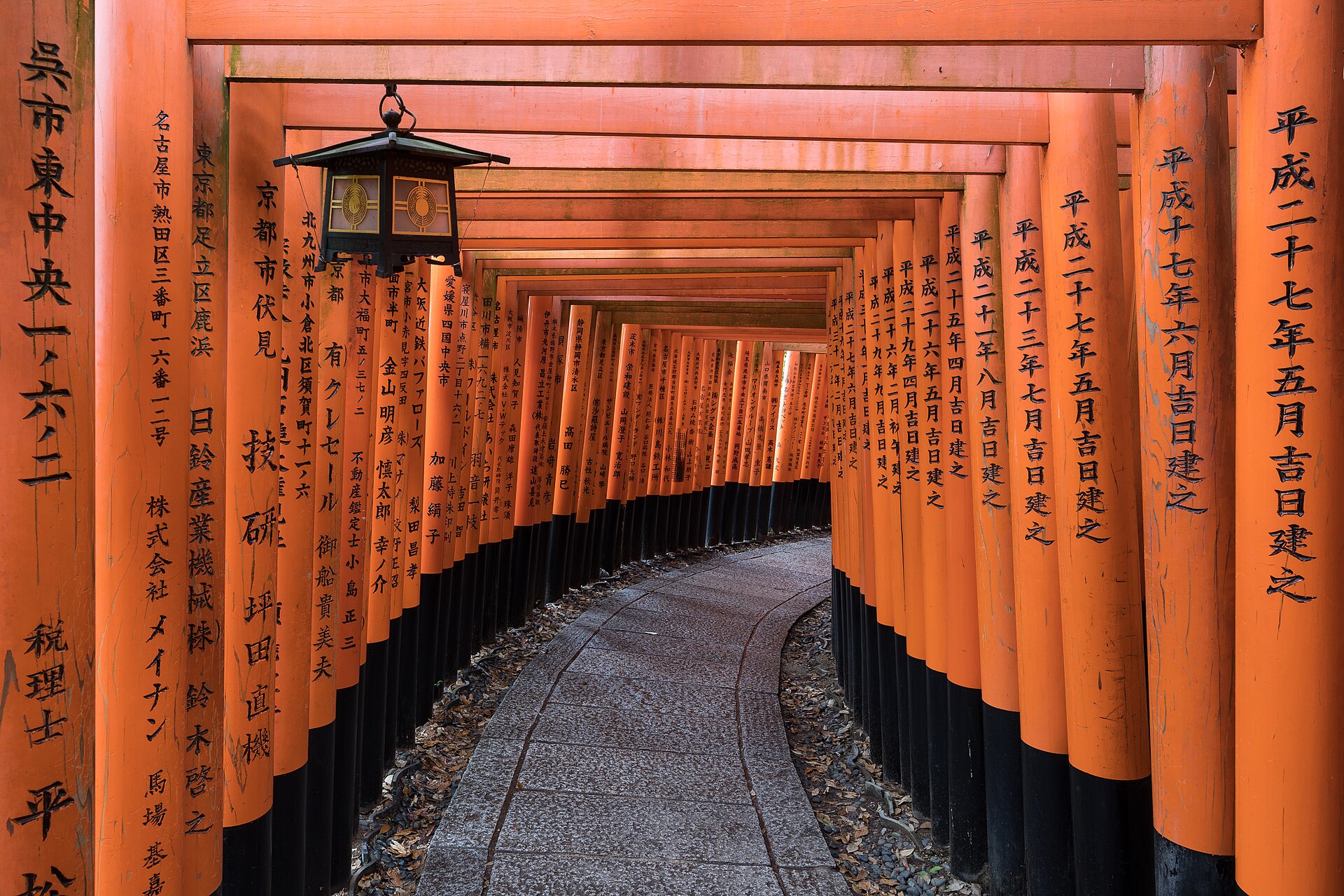

Step off the train at Inari and the colour arrives before the shrine does: a vermilion so saturated it seems to hum. Fushimi Inari-taisha sits at the foot of Inari-san, a low, wooded mountain on Kyoto's southern edge, and from its main halls a path of torii gates winds upward through cedar and bamboo, so densely packed in places that the light inside turns the colour of embers.
Most visitors know the image before they come. What the photographs cannot convey is the sound: the soft scuff of feet on stone, crows in the canopy, the dry rattle of a shrine bell somewhere above. Or the sense, about twenty minutes in, that you have walked out of a city and into something much older.
The storyA god of rice, and of business
This is the head shrine of Inari, the kami of rice, harvests and, by long extension, prosperity of every kind. Tradition dates its founding on the mountain to the early eighth century, before Kyoto was even the capital, and tens of thousands of Inari shrines across Japan trace their lineage back to this hillside. You will meet the smaller ones everywhere: on department-store rooftops, in alleys, wedged between office towers.
Inari's messengers are foxes, and they are on guard throughout the grounds in stone and bronze, sleek and watchful, often with a scroll or a key to the rice granary clasped in their jaws. Many wear red bibs tied by worshippers. Fried tofu is said to be their favourite food, which is why the small sweet pouches of rice called inari-zushi carry the shrine's name.
The torii themselves are offerings. For centuries, merchants, families and companies have donated gates in thanks for success or in hope of it, and the custom shows no sign of fading. Turn around as you climb and you will see the black inscriptions on the uphill side of each pillar: the donor's name, the city they came from, and the date the gate was raised, often marked with the phrase for an auspicious day. Read a few and the tunnel becomes a ledger of private ambitions: a trading firm in Osaka, a tax accountant in Nagoya, a family business three generations old.
Read a few inscriptions and the tunnel becomes a ledger of private ambitions.— On the slopes of Inari-san
The walkUp through the gates
The approach begins at the great two-storey Rōmon gate, traditionally said to have been donated by Toyotomi Hideyoshi, and leads past the main sanctuary to the famous Senbon Torii, the "thousand gates". Here the path splits into two parallel tunnels, the gates so close together that they form near-continuous walls. It is the most photographed stretch of the shrine, and the most crowded.
Keep going. Above the Okusha prayer hall the gates thin and the crowds thin with them. The path rises in stone steps through forest, past small tea houses and clusters of otsuka, stone altars heaped with miniature torii, candles and porcelain foxes left by the devout. Each marks a personal devotion, and together they give the upper mountain the feeling of a village of shrines, crowded and intimate and a little overgrown.
Roughly halfway up, the Yotsutsuji crossroads opens onto a view west across the whole basin of Kyoto. Many people turn back here, and it is a fine place to do so. Those who continue loop around the summit, which, at a modest 233 metres, offers no grand panorama but a hushed cluster of shrines in the trees. The full circuit from the main gate takes most walkers two to three hours at an unhurried pace.
Through the yearWhen to go
Spring
Fresh green maple leaves against the vermilion, and mild air for the climb. Cherry blossoms are scattered rather than spectacular here.
Summer
Humid and loud with cicadas, but the forest canopy and the gate tunnels give real shade. Climb early, and carry water.
Autumn
The best season for the full loop: cool, clear days, long views from Yotsutsuji, and a little maple colour on the upper slopes.
Winter
Crisp and quieter, except in the first days of January, when vast crowds arrive for the year's first shrine visit to pray for a prosperous year.
Know before you goPractical notes
- Go early or late. The grounds are open-air and the lower tunnels fill quickly from mid-morning. Arrive soon after sunrise for empty gates and soft light.
- Climb past the crowds. Most visitors stop within the first stretch. Ten minutes beyond the Okusha, the path is often nearly yours.
- Wear proper shoes. The route is almost entirely stone steps, uneven in places and slick after rain.
- Mind the etiquette. Walk to the side of the central path beneath torii, bow lightly at the main gates, and keep tripods and voices out of the way of people at prayer.
- Stop for something small. The tea houses on the mountain serve simple bowls of kitsune udon, topped with fried tofu for the foxes' sake.