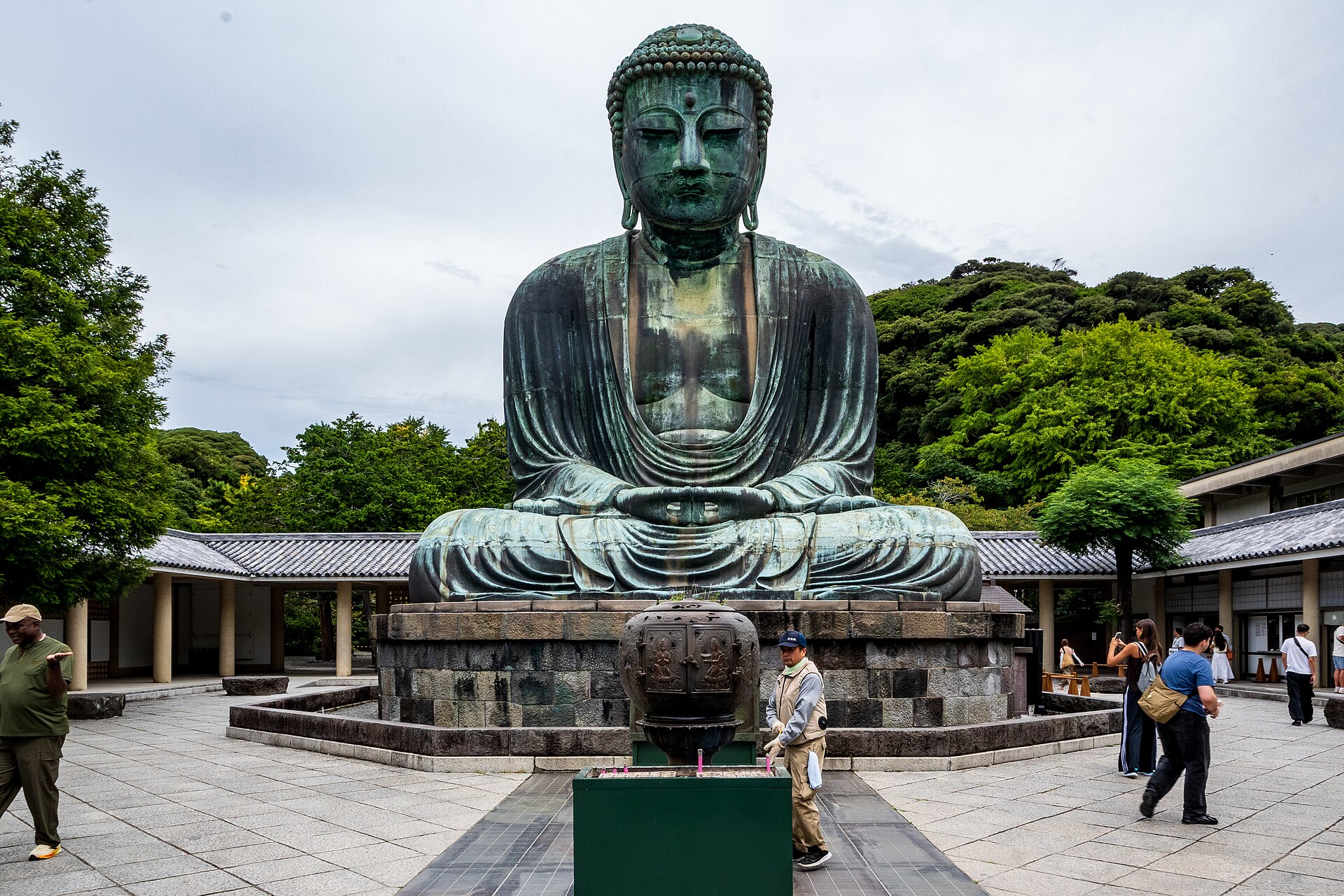

You see the shoulders first. They rise above the gate and the pines like a weathered hill, green as old copper roofing, and then the whole figure resolves: a seated Amida Buddha, hands folded in his lap, eyes half-lowered toward the people moving across the stone courtyard below. He has been sitting like this, in sun, typhoon and snow, for more than five hundred years. There is no hall around him. There is only Kamakura's sky.
Kōtoku-in is a temple of the Jōdo, or Pure Land, school of Buddhism in the Hase district of Kamakura, the seaside town that served as the seat of Japan's first shogunate from the late twelfth century until 1333. Its Great Buddha, the Kamakura Daibutsu, is a designated National Treasure and one of the most recognisable sculptures in the country. Yet the scale is not what lingers. It is the composure: a face of extraordinary calm, cast in metal, keeping its counsel among the cicadas.
The storyA Buddha without a roof
Work on the bronze figure began in 1252, at a time when Kamakura was the political heart of the country and its warrior rulers were eager to give their young city a sacred presence to rival the great Buddha of Nara. The statue was cast in sections and joined, and you can still read the seams as faint horizontal bands across the robe. It stands a little over eleven metres tall and weighs in the region of 120 tonnes. Faint traces of the original gilding still survive near one cheek; elsewhere the surface has settled into a deep verdigris, streaked where centuries of rain have run down the folds.
The Buddha was originally housed in a great wooden hall. That hall was damaged by storms more than once, and the account most often told is that a tsunami in 1498 swept it away for good. It was never rebuilt. If you look closely around the plinth you will find the old foundation stones of the building that once enclosed him, a quiet record of what the sea took.
The open-air setting has shaped how the statue is loved. The poet Yosano Akiko wrote a famous tanka in which she called him a handsome Shakyamuni among the summer trees. She had the wrong Buddha, since this is Amida, the Buddha of Infinite Light, but the line endures, and so does the feeling behind it: that this is a figure meant to be met outdoors, in season, with leaves moving behind him.
There is no hall around him. There is only Kamakura's sky.— In the temple courtyard
The walkWhat you will see
The approach from Hase is brief and slightly uphill, past shops selling rice crackers and sweet-potato soft serve, and through the temple gate guarded by a pair of Niō. Then the courtyard opens and the Buddha sits straight ahead. In front of him stands a large bronze incense burner, its sides worked with figures in relief, and on most days a thin grey ribbon of smoke rises from it. Stop here before you go closer. From this distance the proportions make sense: the slightly forward-leaning head, the heavy-lidded gaze angled down to meet a standing worshipper, the hands resting in Amida's meditation mudra, thumbs and forefingers touching.
Walk the full circle. From the side, the curve of the back and the weight of the shoulders read almost like landscape, and from behind you can see the two window-like openings in the back of the statue, a reminder that the Buddha is hollow. For much of its modern life visitors have been able to step inside the body and look up at the joins and casting marks from within, an oddly intimate view of thirteenth-century metalwork. Along the side of the grounds hang enormous woven straw sandals, offerings made for the Buddha to wear should he ever choose to walk.
The precinct is compact, ringed with low tiled cloisters and backed by a steep wooded hill. Give it time anyway. The pleasure of Kōtoku-in is less in ticking anything off than in sitting on the edge of the courtyard and watching how the light, and the crowd, change the face in front of you.
Through the yearWhen to go
Spring
Cherry blossom softens the courtyard edges and the bronze reads almost blue against pale petals. Expect Kamakura at its busiest.
Summer
The hills behind turn a dense, humid green and the cicadas are loud. Early mornings are kinder than afternoons.
Autumn
Clear air and warm low sun bring out the gold and rust in the patina. Our favourite season for the statue.
Winter
Crisp, quiet days with sharp shadows. On rare snowy mornings the Buddha's shoulders hold a thin white mantle.
Know before you goPractical notes
- Arrive early. Kamakura is a popular day trip from Tokyo and Yokohama, and the courtyard fills steadily from mid-morning, especially at weekends.
- Pair it with Hase-dera. The hillside Kannon temple is a few minutes' walk away, with views over Sagami Bay and a famous display of hydrangeas in the rainy season.
- Mind the incense. If you offer incense, light it from the flame provided, place it in the burner and waft a little smoke toward yourself, as local visitors do.
- Photograph with patience. Stand back near the gate for the whole figure, then move to the side for the profile. Crowds thin in waves, so wait for a gap.
- Walk the coast after. Yuigahama beach is a short stroll downhill, a good place to let the morning settle.