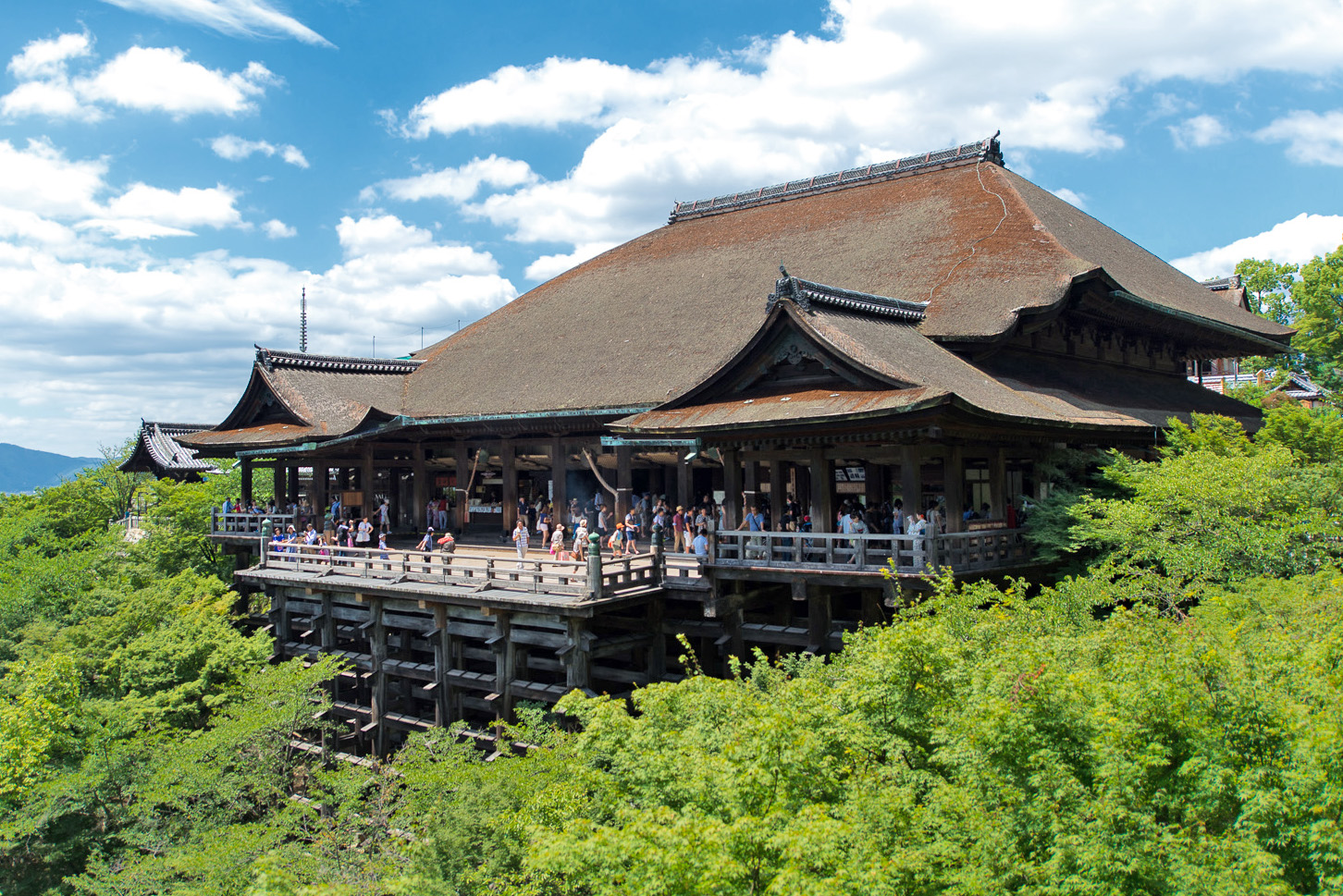

Most temples ask you to look up. Kiyomizu-dera asks you to look out. Its main hall sits on the flank of Otowa-san in Kyoto's eastern hills, and rather than level the slope, its builders simply extended the floor into thin air, propping a great veranda on a forest of timber pillars. Step onto it and the city opens below you, the ravine falls away beneath your feet, and the roof above feels close enough to touch.
The name means "pure water", after the spring that still runs from the hillside below the hall. Everything here, from the climb through the old lanes to the final sip from the falls, is organised around that idea of height and clarity. It is one of the most visited places in Japan, and on a busy afternoon it can feel like it. Yet the architecture is so assured, and the setting so generous, that the crowds rarely manage to diminish it.
The storyA hall built on faith and timber
Temple tradition dates the founding to 778, when a monk named Enchin was guided to the Otowa spring in a vision. A few years later the warrior Sakanoue no Tamuramaro, hunting deer on the hillside, met the monk, was moved by his teaching and became the temple's great patron. The story places Kiyomizu-dera before Kyoto itself became the capital, and the temple has watched the city grow up in the valley below ever since.
Fire has taken the buildings many times. What you see today largely dates from the 1630s, when the complex was rebuilt under the patronage of the shogun Tokugawa Iemitsu. The Hondō, the main hall, is designated a National Treasure, and the temple forms part of the UNESCO World Heritage listing for the Historic Monuments of Ancient Kyoto. Its roof is laid in hinoki cypress bark, layered thick and soft as felt, and the gentle swoop of its eaves is the work of carpenters who knew exactly how wood ages under rain.
The famous stage is the real marvel. It rests on a grid of tall zelkova pillars braced by horizontal beams, a structure assembled with joinery rather than nails, so that the whole frame can give a little when the ground shakes. The Japanese saying "to jump from the stage of Kiyomizu" means to take a bold, irrevocable leap, and once you stand at the rail and look down into the treetops you understand precisely why.
Most temples ask you to look up. Kiyomizu-dera asks you to look out.— On the Hondō stage
The walkFrom the lanes to the falls
The approach is half the pleasure. Kiyomizu-zaka climbs steadily from the Higashiyama streets, lined with shops selling pottery, pickles and sweets, and the stone-stepped lanes of Sannen-zaka and Ninen-zaka wind in from the north past wooden townhouses. At the top, the vermilion Niō-mon gate and the three-storied pagoda behind it announce the temple in a blaze of red against the green of the hill.
Inside the Hondō the light drops and the air smells of incense and old wood. The principal image, an eleven-headed, thousand-armed Kannon, is a hidden Buddha, kept from view and revealed only on rare occasions, so the hall is less a place to see than a place to feel the weight of centuries. Then you walk out onto the stage, and the scale of the place reverses: suddenly you are suspended above the canopy, with the city spread out to the west.
Continue along the path to the Okunoin hall for the view that appears on every postcard, the stage seen side-on across the ravine, its pillars sinking into the leaves. From there the path descends through the trees to the Otowa waterfall, where three thin streams spill from a stone ledge. Visitors queue with long-handled cups to drink, each stream traditionally linked to a different blessing. Choose one; taking all three is considered greedy.
Through the yearWhen to go
Spring
Cherry trees fringe the hillside and the stage looks out over drifts of pale pink in early April.
Summer
The maples turn the ravine into a deep green cushion, as in our photograph; come early, before the heat settles.
Autumn
The great season. The valley below the stage burns red and amber from mid to late November.
Winter
The quietest months. A rare dusting of snow on the cypress roof is the most coveted sight of all.
Know before you goPractical notes
- Arrive at opening. The temple opens early, and the first hour is cooler, quieter and kinder to photographs than anything that follows.
- Wear proper shoes. The lanes are steep and the paths below the stage are uneven stone; leave the sandals for later.
- Walk the full loop. Many visitors turn back at the stage. Carry on to Okunoin and down to the Otowa falls for the best views of the hall.
- Keep the camera outside. Photography is not permitted in the inner sanctum of the halls; save it for the stage and the gardens.
- Link it with the old town. Leave by Sannen-zaka and Ninen-zaka and drift north through Higashiyama towards Gion for an easy half-day on foot.