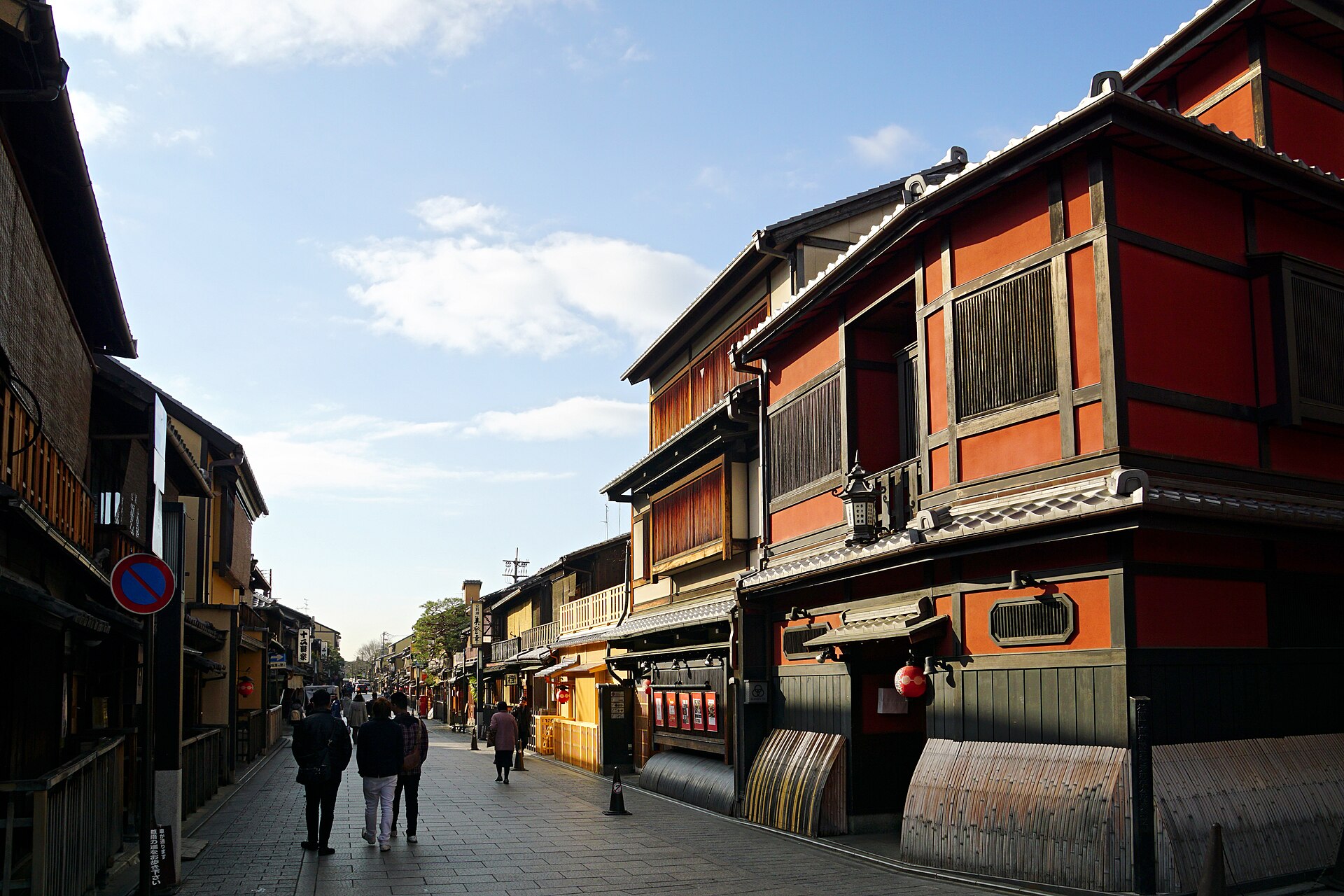

Gion does not perform for you, and that is the first thing to understand about it. Its facades are made to be looked past: slatted windows that let the inside see out, curtains that stop at the knee, doors that slide shut with a soft wooden knock. Walk Hanamikōji-dōri in the hour before dusk and the street seems almost empty of purpose. Then a lantern is lit, a taxi idles at a doorway, and the quarter begins to work.
This is Kyoto's most famous kagai, or "flower town", one of a handful of districts where geiko and their apprentices, maiko, still train, entertain and live by a calendar older than the city's railways. Most visitors will never step inside an ochaya. They do not need to. The pleasure of Gion lies in its surfaces, its rhythms and its restraint, and in the sense, never quite dispelled, that the real evening is happening one wall away.
The storyA quarter grown from a shrine gate
Gion began as a place of pilgrims. Its name comes from the old title of Yasaka Shrine, whose vermilion west gate still closes the eastern end of Shijō-dōri. Teahouses grew up along the approach to serve the crowds, offering tea and sweets, then food and sake, then music and dance. By the Edo period the quarter had become one of the great entertainment districts of Japan, and the Kamo River banks below it carried the noise of kabuki theatres, of which the Minamiza on Shijō is the survivor.
The architecture is the street's signature. Kyoto townhouses, machiya, are narrow at the front and deep at the back, and the ochaya of Gion refine the type: walls washed in bengara, the iron-oxide red you see in the photograph, upper storeys screened by fine timber lattice, and at street level the curved bamboo fences called inuyarai, which keep splashes, carts and, so the name suggests, dogs off the plaster. Small wooden plaques beside some doors carry the names of the maiko and geiko attached to the house.
The ochaya themselves remain private. Custom holds that a first-time guest is not received without an introduction from a patron, a rule known as ichigen-san okotowari. It can sound like snobbery. In practice it is how a house that bills on trust, books performers on your behalf and remembers your tastes for decades protects its relationships. Gion's quiet is not an accident; it is the product.
The real evening is always happening one wall away.— On Hanamikōji-dōri
The walkThree streets and a canal
Start on Shijō-dōri, loud with shops, and turn south onto Hanamikōji-dōri. The noise falls away within a block. The flagstones are clean, the eaves low, the colours a narrow palette of rust, charcoal and paper white. Keep going and the street ends at Kennin-ji, Kyoto's oldest Zen temple, where raked gravel and a famous painted ceiling of twin dragons make an unexpected full stop to the walk.
Then cross back north of Shijō to the Shirakawa, a shallow canal that runs between stone banks under weeping willows. Here Gion Shinbashi is perhaps the most complete streetscape in the city, a protected run of teahouses along Shinbashi-dōri and the canal bank, where upper rooms look down onto the water. At its corner stand Tatsumi-bashi, a small bridge over the Shirakawa, and the little Tatsumi Daimyōjin shrine, a favourite of the quarter's performers. Linger on the bridge long enough and you will hear the water before you hear anyone speak.
If you see a maiko, you will know her by the long trailing obi, the elaborate hair dressed with seasonal ornaments, and the tall wooden okobo that make her step short and careful. She is almost certainly on her way to work. Let her pass.
Through the yearWhen to go
Spring
Cherry blossom over the Shirakawa, and the Miyako Odori, Gion Kōbu's spring dance programme, when the quarter opens its art to the public.
Summer
July belongs to the Gion Matsuri of Yasaka Shrine, with towering floats, festival music and evenings of yukata on every street.
Autumn
Soft light and fewer crowds; the maples of Kennin-ji and the hills behind Yasaka turn while the streets stay calm.
Winter
Clear, low sun that sets the red plaster glowing, and on New Year's Eve the crowds at Yasaka carrying home sacred fire on twisted ropes.
Know before you goPractical notes
- Never chase a maiko. Do not block, touch or follow performers for a photograph. They are working, and residents have long asked visitors to keep a respectful distance.
- Mind the private lanes. Many of the side alleys off Hanamikōji-dōri are private property, and posted signs ask visitors not to photograph there. Stay on the main streets.
- Go early or go late. Morning brings swept stones and shuttered doors; dusk brings lanterns and the first taxis. Midday is the least rewarding hour.
- Seek a sanctioned performance. The seasonal dances and a number of public venues offer a way to see geiko and maiko arts without an introduction.
- Combine on foot. Gion sits between Yasaka Shrine, Kennin-ji and the lanes that climb towards Kiyomizu-dera, so it pairs naturally with a long walking day in Higashiyama.