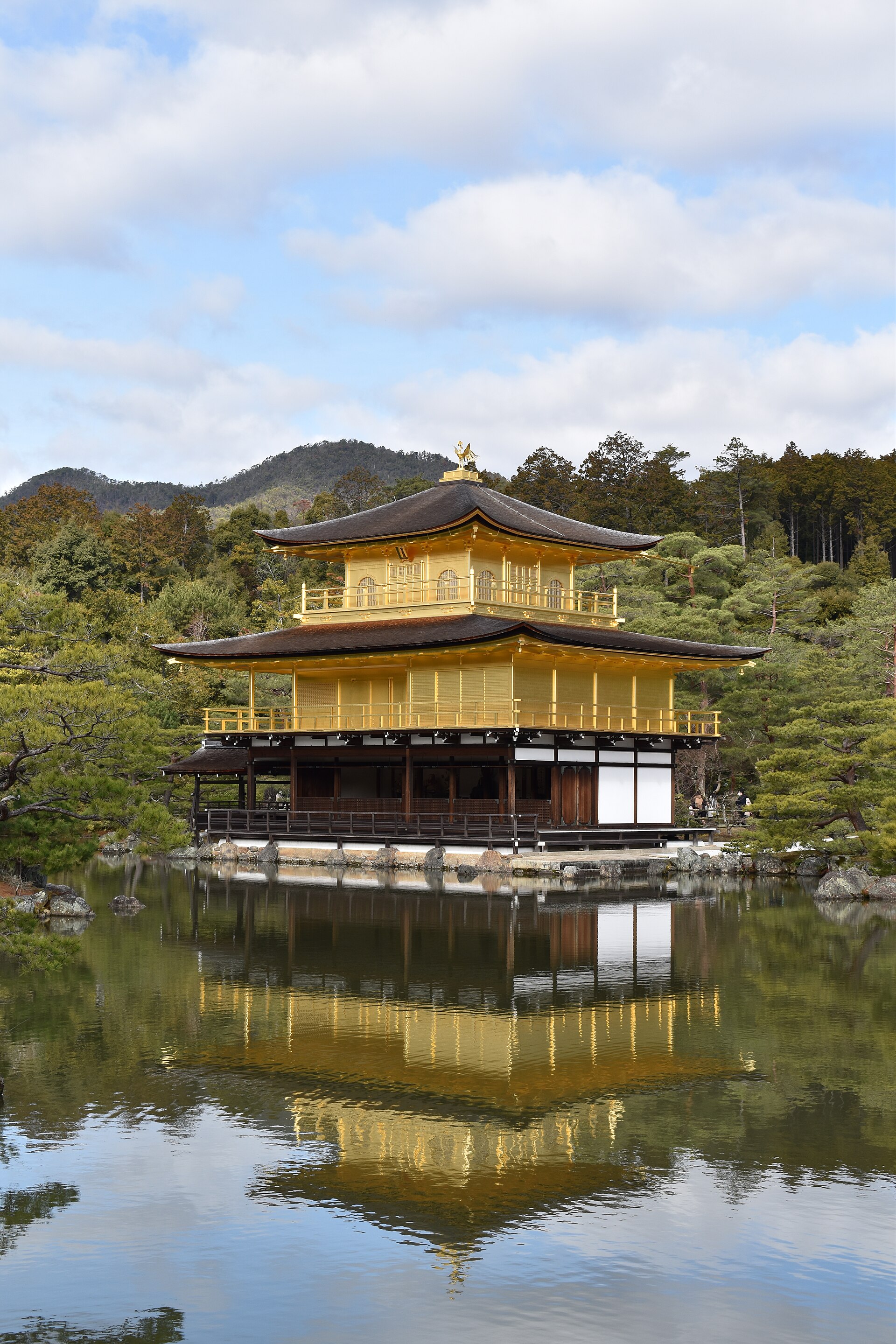

You come round a bend in the gravel path, past a screen of clipped pines, and there it is: a building made of light. The Golden Pavilion stands at the water's edge with its two upper floors wrapped in gold leaf, and the pond in front of it is so calm that the whole structure appears twice, once in the air and once upside down in the green-black water. For the first few seconds, even the tour groups fall quiet.
Kinkaku-ji may be the most photographed building in Kyoto, and it would be easy to treat it as a single picture to collect and leave. That would be a mistake. The pavilion is the centrepiece of a garden designed to be walked, a Zen temple with a tangled six-hundred-year story, and a lesson in how the Japanese aesthetic of the late fourteenth century used extravagance and restraint in the same breath.
The storyA shogun's villa, a monk's fire
The temple's formal name is Rokuon-ji, the Deer Park Temple. It began as a retirement villa for Ashikaga Yoshimitsu, the third shogun of the Ashikaga line, who in the 1390s acquired an aristocratic estate in the wooded northwest of the city and built himself a retreat fit for a man who overshadowed the imperial court and opened formal relations with Ming China. After his death in 1408, according to his wishes, the villa became a Zen temple of the Rinzai school, and so it has remained.
Look closely and you will see that each floor speaks a different architectural language. The ground floor, left in plain wood and white plaster, follows the palace style of the Heian nobility. The second floor takes the form of a samurai residence, and the top floor is a Chinese-style Zen hall with bell-shaped windows, crowned by a gilt-bronze phoenix. Aristocrat, warrior and priest stacked one above the other: Yoshimitsu's idea of his own position, rendered in timber and gold.
The building you see is not his. In 1950 a young acolyte set fire to the pavilion and it burned to the ground, an act that shocked the country and later became the subject of Yukio Mishima's novel The Temple of the Golden Pavilion. A faithful reconstruction was completed in 1955, and in 1987 the gilding was renewed with leaf thicker than before, which is why the surface today has such a deep, buttery glow. In 1994 the temple was inscribed as part of the Historic Monuments of Ancient Kyoto World Heritage Site.
Aristocrat, warrior and priest stacked one above the other, rendered in timber and gold.— On the three floors of the pavilion
The walkAround the mirror pond
The pond is called Kyōko-chi, the Mirror Pond, and the name is literal. Its surface is studded with small islands of rock and pine, each placed to break the reflection just enough to make the eye keep moving. The classic view is from the southern shore near the entrance, and it is here that the crowd gathers. Hold your ground for a minute, wait for a gap, and then move on, because the pavilion changes as you walk.
The path is one-way and follows the shore around the pond, bringing you close to the building itself. You cannot go inside, but from this angle you see the details that vanish at a distance: the delicate railings, the shingled roofs of cypress bark, the way the gold catches even on an overcast day. Beyond, the garden climbs into the hillside. Look for the Ryūmon-taki, a small waterfall with a stone at its foot said to represent a carp leaping upstream, a Chinese image of perseverance rewarded. Higher still, the Sekka-tei teahouse, added in the Edo period, looks back over the treetops toward the pavilion roof.
The exit leads past a cluster of small halls and stalls selling incense and amulets. Most visitors leave quickly. Take a moment instead to notice how thoroughly the hill has hidden the pavilion behind you: the garden was built so that its great reveal happens once, and only from the water.
Through the yearWhen to go
Spring
Fresh maple leaves and soft green pines frame the gold. The garden is less known for cherry blossom than other Kyoto temples, which keeps it a little calmer.
Summer
Deep shade, cicadas, and a vivid contrast between gold and dense foliage. Go early, before the heat and the tour buses.
Autumn
The hillside maples turn red behind the pavilion and the light grows low and warm. The busiest season of the year.
Winter
Clear, cold days give the sharpest reflections. On the rare mornings after snowfall the roofs turn white above the gold, and all of Kyoto seems to come to see it.
Know before you goPractical notes
- Arrive at opening. The first half hour offers the stillest water and the thinnest crowds on the southern shore.
- Keep your ticket. Admission comes as a paper talisman printed with calligraphy, a small souvenir worth tucking into a notebook.
- Pick the sun. The pavilion faces south across the pond, so it is lit from the front for much of the day. Bright, still conditions make the reflection.
- Pair it with Ryōan-ji. The famous rock garden lies a short walk southwest along the Kinukake-no-michi, a quiet road that also leads on to Ninna-ji.
- See the sequel. Ginkaku-ji, the Silver Pavilion, was built by Yoshimitsu's grandson on the other side of the city. Visiting both shows how far taste moved in a single family.